|
MAINE GENEALOGY EXPRESS |
|

|
STATE BIRD: Chickadee
BLACK-CAP TITMOUSE.
|
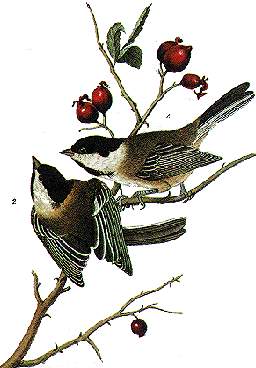
| The opinion generally entertained respecting the extensive
dispersion of the Black-cap Titmouse, has in all probability
originated from the great resemblance which it bears to the
Carolina Titmouse, Parus Carolinensis, that species being now
known to extend its spring and summer migrations as far eastward
as the State of New Jersey, where it has been found breeding by
my friend EDWARD HARRIS, Esq. of Moorestown. The Black-cap, on
the other hand, is rarely observed farther south, and then only
in winter, when it proceeds as far as beyond the middle portions
of Maryland, from whence I have at that season received
specimens in spirits, collected by my friend Colonel THEODORE
ANDERSON of Baltimore. Westward of the Alleghanies it extends as
far as Kentucky in winter, but at the approach of spring returns
northward. In Pennsylvania and New Jersey some are known to
breed; but as the Carolina Titmouse breeds there also, it is
difficult to say which of them is the most numerous, they being
so like each other that one is apt to confound them. In the
State of New York it is abundant, and often rears two broods in
the season; as you proceed eastward you may observe it in all
places favourable to its habits; and, according to Dr.
RICHARDSON, it is found as far north as lat. 65, it being in the
Fur Countries the most common bird, "a small family inhabiting
almost every thicket." None were seen by Mr. TOWNSEND either on
the Rocky Mountains or about the Columbia river, where, on the
contrary, Parus Carolinensis is abundant, as it is also in the
Texas, where I found it breeding in the spring of 1837. Although
bearing a considerable resemblance to the Marsh Titmouse of
Europe, P. palustris, it differs from that species not only in
colour, but more especially in its habits and notes.
Hardy, smart, restless, industrious, and frugal, the Black-cap Titmouse ranges through the forest during the summer, and retiring to its more secluded parts, as if to ensure a greater degree of quiet, it usually breeds there. Numerous eggs produce a numerous progeny, and as soon as the first brood has been reared, the young range hither and thither in a body, searching for food, while their parents, intent on forming another family, remain concealed and almost silent, laying their eggs in the hole deserted by some small Woodpecker, or forming one for themselves. As it has been my fortune to witness a pair at this work, I will here state what occurred, notwithstanding the opinion of those who inform us that the bill of a Titmouse is "not shaped for digging." While seated one morning under a crab-apple tree (very hard wood, reader), I saw two Black-cap Titmice fluttering about in great concern, as if anxious to see me depart. By their manners indeed I was induced to believe that their nest was near, and, anxious to observe their proceedings, I removed to the distance of about twenty paces. The birds now became silent, alighted on the apple-tree, gradually moved towards the base of one of its large branches, and one of them disappeared in what I then supposed to be the hole of some small Woodpecker; but I saw it presently on the edge, with a small chip in its bill, and again cautiously approached the tree. When three or four yards off I distinctly heard the peckings or taps of the industrious worker within, and saw it come to the mouth of the hole and return many times in succession in the course of half an hour, after which I got up and examined the mansion. The hole was about three inches deep, and dug obliquely downward from the aperture, which was just large enough to admit the bird. I had observed both sexes at this labour, and left the spot perfectly satisfied as to their power of boring a nest for themselves. The Black-cap Titmouse, or Chickadee, as it is generally named in our Eastern States, though exceedingly shy in summer or during the breeding season, becomes quite familiar in winter, although it never ventures to enter the habitations of man; but in the most boisterous weather, requiring neither food nor shelter there, it may be seen amidst the snow in the rugged paths of the cheerless woods, where it welcomes the traveller or the woodcutter with a confidence and cheerfulness far surpassing the well-known familiarity of the Robin Redbreast of Europe. Often, on such occasions, should you offer it, no matter how small a portion of your fare, it alights without hesitation, and devours it without manifesting any apprehension. The sound of an axe in the woods is sufficient to bring forth several of these busy creatures, and having discovered the woodman, they seem to find pleasure in his company. If, as is usually the case, he is provided with a dinner, the Chickadee at once evinces its anxiety to partake of it, and loses no opportunity of accomplishing its object, although it sets about it with much circumspection, as if it were afraid of being detected, and brought to punishment. A woodcutter in Maine assured me, that one day he happened to be at work, and had scarcely hung up his basket of provisions, when it was observed by a flock of these birds, which, having gathered into it at once, attacked a piece of cold beef; but after each peck, he saw their heads raised above the edge, as if to guard against the least appearance of danger. After picking until they were tired or satisfied, they left the basket and perched directly over his fire, but out of the direction of the smoke. There they sat enjoying themselves and ruffling their feathers to allow the warmth more easy access to their skin, until he began his dinner, when they immediately alighted near him, and in the most plaintive tones seemed to solicit a portion. WILSON and others have spoken of this species as being addicted to moving in the company of our smaller Woodpeckers and Brown Creepers, and this in such a way as to induce most readers to believe the act to be customary; but I have often found groups of them, at times composed of more than a dozen, without any such companions, and I should be more inclined to think that the Downy Woodpecker, and the Brown Creeper, seek the company of the Titmice, rather than that the latter associate with them. Often indeed have I watched the busy Chickadees, as they proceeded from tree to tree, and from branch to branch, whether by the road-side or in the interior of the forest, when no other birds were with them. The light rustling sound of their concave wings would intimate their approach as well as their retreat, as gaily one after another they passed onwards from one spot to another, chattering, peeping everywhere, and determined as it were, not to suffer a chink to pass without inspection. Now hanging, back downward, at the extremity of a twig, its feet almost up to its bill, it would peck at a berry or a seed until it had devoured it, or it had fallen to the ground: should the latter be the case, the busy bird would at once fly down, and hammer at the fruit. To the Black-cap Titmouse the breaking of a hazel-nut is quite a pleasure, and I have repeatedly seen the feat accomplished not only by a bird in its natural state, but by one kept in confinement. Courageous and at times exceedingly tyrannical, it will attack young birds, break their skulls, and feed upon their flesh, as I have more than once witnessed. In this habit they resemble the Jays, but in every other they differ entirely from those birds although the PRINCE of MUSIGNANO has thought fit to assimilate the two groups. The Chickadee feeds on insects, their larvae, and eggs, as well as on every sort of small fruit, or berries, including grapes, acorns, and the seeds of various pines. I have seen them eat the seeds of the sunflower, the pokeberry, and pears, as well as flesh of all kinds. Indeed it may be truly called omnivorous. Often, like Jays, you may see them perched as it were upon their food, and holding it beneath their feet while pecking at it; but no Jays are seen to hang head downwards at the end of a branch. My friend THOMAS M`CULLOCH, Esq. of Halifax, in Nova Scotia, has favoured me with the following interesting remarks having reference to this species. "Sometimes I have been inclined to think, that the sight of this bird is comparatively imperfect, and that it is chiefly indebted to some of the other senses for its success in obtaining subsistence. This idea may not be correct, but it seems to derive some support from the little incident which I am about to mention. While standing at the edge of a patch of newly-felled wood, over which the fire had recently passed, and left every thing black in its course, I observed a small flock of these birds coming from the opposite side of the clearing. Being dressed in black and aware of their familiarity, I stood perfectly motionless, for the purpose of ascertaining how near they would approach. Stealing from branch to branch, and peering for food among the crevices of the prostrate trunks, as they passed along, onward they came until the foremost settled upon a small twig a few feet from the spot upon which I stood. After looking about for a short time it flew and alighted just below the lock of a double-barrelled gun which I held in a slanting direction below my arm. Being unable however to obtain a hold, it slided down to the middle of the piece, and then flew away, jerking its tail, and apparently quite unconscious of having been so near the deadly weapon. In this country these birds seem to be influenced by a modification of that feeling by which so many others are induced to congregate at the close of autumn and seek a more congenial clime. At that period they collect in large flocks and exhibit all the hurry and bustle of travellers, who are bent upon a distant journey. If these flocks do not migrate, their union is soon destroyed, for when the Black-cap Titmice again appear, it is in small flocks; their former restlessness is gone, and they now exhibit their wonted care and deliberation in searching for food." The nest of this species, whether it be placed in the hole of a Woodpecker or squirrel, or in a place dug by itself, is seldom found at a height exceeding ten feet. Most of those which I have seen were in low broken or hollowed stumps only a few feet high. The materials of which it is composed vary in different districts, but are generally the hair of quadrupeds, in a considerable quantity, and disposed in the shape of a loose bag or purse, as in most other species which do not hang their nests outside. Some persons have said that they lay their eggs on the bare wood, or on the chips left by Woodpeckers; but this is not the case, in so far as I have examined them; and in this my observations are confirmed by those of Dr. BREWER of Boston and Mr. M`CULLOCH of Halifax, who also have inspected nests of this species. The eggs rarely exceed eight in number they measure five-eighths of an inch in length, by three-eighths and three-quarters, are rather pointed at the smaller end, white, slightly sprinkled with minute dots and markings of little reddish. Those of the first brood are deposited from the middle of April to that of May; for the second about two months later. The parents I have thought generally move along with the young of the second brood. Dr. BREWER says, "on the 20th of June, I found in a single Titmouse's hole a mass of the hair of the common skunk and moss large enough to weigh two or more ounces, and sufficient to construct a nest for some of our larger birds, such for instance as Wilson's Thrush." Mr. M`CULLOCH found a nest of this bird placed about two feet from the ground in a small stump, which seemed to have been excavated by the birds themselves. It contained six young, and was lined entirely with the hair which cattle, in rubbing themselves, had left upon the stump. The flight of this species, like that of all our American Titmice, is short, fluttering, generally only from tree to tree, and is accompanied with a murmuring sound produced by the concavity of the wings. It is seldom seen on the ground, unless when it has followed a fruit that has fallen, or when searching for materials for its nest. It usually roosts in its nest during winter, and in summer amid the close foliage of firs or evergreens. In winter, indeed, as well as often in autumn, it is seen near the farm-houses, and even in villages and towns, busily seeking for food among the trees. "On seeing a cat, or other object of natural antipathy," says Mr. NUTTALL, "the Chickadee, like the peevish Jay, scolds in a loud, angry, and hoarse note, 'tshe, daigh daigh daigh. Among the other notes of this species, I have heard a call like tshe-de-jay, tshe-de-jay, the two first syllables being a slender chirp, with the jay strongly pronounced. The only note of this bird which may be called a song, is one which is frequently heard at intervals in the depths of the forest, at times of day usually when all other birds are silent. We then may sometimes hear in the midst of this solitude two feeble, drawling, clearly whistled, and rather melancholy notes like 'te-derry, and sometimes ye-perrit, and occasionally, but more rarely in the same wiry, whistling, solemn tone, 'phebe. The young in winter also sometimes drawl out these contemplative strains. In all cases the first syllable is very high and clear, the second word drops low, and ends like a feeble plaint. This is nearly all the quaint song ever attempted by the Chickadee. On fine days, about the commencement of October, I have heard the Chickadee sometimes, for half an hour at a time, attempt a lively, petulant warble, very different from his ordinary notes. On these occasions he appears to flirt about, still hunting for his prey, in an ecstasy of delight and vigour. But after awhile the usual drawling note again occurs. These birds, like many others, are very subject to the attacks of vermin, and they accumulate in great numbers around that part of the head and front which is least accessible to their foot." BLACK-CAPT TITMOUSE, Parus atricapillus, Wils. Amer.
Orn., vol. i. p. 134. BLACK-CAPT TITMOUSE, Parus atricapillus, Aud. Orn. Biog., vol. iv. p. 374. Adult Male. Bill short, straight, strong, compressed, rather obtuse; both mandibles with the dorsal line slightly convex, the sides sloping and convex, the edges sharp, that of the upper mandible slightly sinuate. Nostrils basal, roundish, concealed by the recumbent feathers. Head large, neck short, body robust. Feet of ordinary length, rather robust; tarsus compressed, with seven anterior scutella; toes large, the three anterior united as far as the second joint; the hind one much stronger, and with its claw nearly as long as the middle toe. Claws large, arched, much compressed, acute. Plumage blended, tufty; feathers of the head glossy. Wings of moderate length, the first quill scarcely half the length of the second, which is equal to the first secondary, the third and seventh about equal, the fourth and fifth equal and longest. Tail long, a little arched, emarginate and rounded, of twelve slender rounded feathers. Bill brownish-black. Iris dark brown. Feet greyish-blue, as are the claws. The whole upper part of the head and the hind neck pure black, as is a large patch on the throat and fore-neck. Between these patches of black is a band of white, from the base of the bill down the sides of the neck, becoming broader behind, and encroaching on the back, which, with the wing-coverts, is ash-grey tinged with brown. Quills dark greyish-brown, margined with bluish-white, the secondary quills so broadly margined as to leave a conspicuous white dash on the wing; tail of the same colour, the feathers similarly edged. Lower parts brownish-white, the sides pale yellowish-brown. Length to end of tail 5 1/8 inches, to end of wings 3 7/8, to end of claws 4 1/2; extent of wing 8 1/4; wing from flexure 2 10/12; tail 2 9/12; these measurements taken from three males. In another, the bill along the ridge (4 1/2)/12, along the edge of lower mandible 7/12; tarsus 7/12; hind toe 3/12, its claw 4/12; middle toe 5/12, its claw 3/12. Adult Female. The Female is similar to the male. Male examined. The tongue is 4 1/2 twelfths long, emarginate and papillate at the base, flat above, depressed, tapering, the point horny, slit, with four bristly points. OEsophagus, [b, c, d], 1 1/2 inches long, tapering at the commencement to the diameter of 2 twelfths, and then continuing nearly uniform, without dilatation; the proventriculus, [c, d], is not much enlarged. The stomach, [d, e], is a strong gizzard, of an oblong form or ovate, 4 twelfths long, 3 twelfths broad, with strong lateral muscles; its epithelium longitudinally rugous, and of a dark reddish-brown colour. Intestine 7 1/4 inches long, the diameter of its duodenal portion, [f, g, h], 2 1/2 twelfths. The rectum, [g, k], is 7 1/2 twelfths long; the coeca, [j], 1 twelfth long, and 1/4 twelfth in diameter. The trachea is 1 2/12 inches long, its diameter uniform, 3/4 twelfths, its rings 42. It is furnished with lateral or contractor muscles, sterno-tracheal, and four pairs of inferior laryngeal. Bronchi short, of about 10 rings. (Source: http://www.50states.com/bird/chickade.htm) |
...
|
CLICK HERE to RETURN to MAINE INDEX PAGE |
|
GENEALOGY EXPRESS Free Genealogy Research is My Mission This Webpage has been created by Sharon Wick exclusively for Genealogy Express ©2008 Submitters retain all copyrights |