|
CHAPTER III.
A MILL, A
MEETING-HOUSE, AND WAR.
1681-1700
THE history of Derby might very properly be
considered in three periods, characterized by the
different pursuits of the inhabitants during those
periods. The first was purely agricultural,
the second commercial, and the third or present,
manufacturing. Each period has developed its
master spirits, most of whom, having fulfilled their
destiny, have left lasting impressions for the
benefit of coming generations.
In this age of civilization, when the people are borne
from village and town to and from the great centers
of business with the speed of lightning, when the
waters swarm with the whitening sails of commerce,
when cities are rising by magic, factory upon
factories springing up like mushrooms along the
rivers to increase our products, followed by neat
little cottages, beautiful country seats, and costly
mansions, occupied by a population happy and
resplendent in the accumulated wealth of the dead
and the living, they can know but little of the
trials and impediments that stood in the way of our
ancestors, when they first pressed their footsteps
into the untrodden wilderness, and for many years
thereafter. When the white settler first
reposed on Riggs hill, all that his eye rested upon
was wild, coy, anduncultivated wilderness, seemingly
as from the first dawn of creation. the
forest, dense with the oak, the chestnut, the pine,
the hemlock, the walnut, the cedar and the elm, all
growing in luxuriant majesty, obscured from hu8man
eye the rising and setting sun while it sheltered
and protected the deer, the wolf, the bear, the
catamount and other wild animals in great variety,
from the hunter's long and weary pursuit. The
Indian, content with his cherished games, still
roamed at times over his ancient hunting grounds,
while his mate prepared for him his feast of fish
and fowl and moose, governed by no rule save the
pangs of hunger.
Pg. 76 -
Thus began the first period, the settlers, after
clearing a few spots must have obtained their food,
clothing, tools, necessaries of life, and few
comforts, almost exclusively from the soil,
preparing them for use mostly with their own hands,
for it is true that the first period passed under
the reign of slavery, wherein much of the heavy toil
was borne by servants, for there was scarcely a
family during the first seventy-five years but that
had
Page 77 -
it wise to cultivate the heart and religious
thought, without the present dash and extravagances
of that which is only life for the present world.
THE FIRST MILL
The inhabitants of Derby having toiled patiently
twenty-seven years in securing a town settlement,
passing through many difficulties, and one Indian
war season, and having attained public notice as a
people, and some reliability as to property,
proposed to make some improvements as to comforts,
and voted: "At a town meeting Aug. 29, 1681,
to encourage such a man as will build a sufficient
mill for the town of Derby, by giving him twenty
pounds and build a dam, provided it shall be in such
a place
Page 78 -
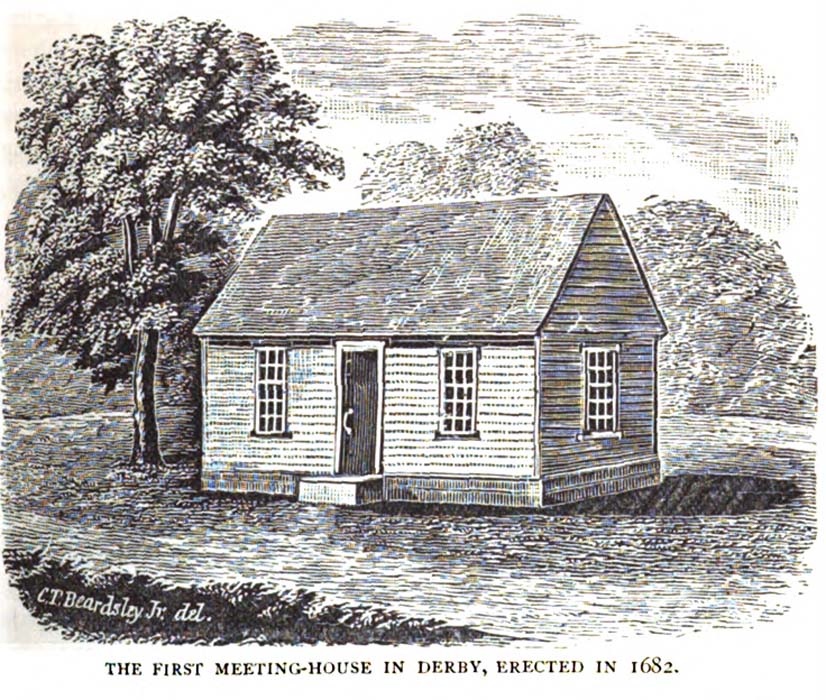
THE FIRST
MEETING-HOUSE IN DERBY.
The location of a meeting-house was difficult task
very often in the towns of Connecticut, and was more
frequently done by a committee from the General
Court, but Derby men determined to practice the
rights of freemen and settle this question upon that
ground; for on Nov. 22, 1680, they passed a vote
that "all the inhabitants of the town (i. e. voters)
should have liberty to put in their votes, where the
meeting house should stand," thus deciding to be
governed by the majority. At this time there
was no eccleastical organization in the town, aside
from the town. A church had been organized,
but whether its membership consisted of the free
voters of the town or otherwise, there is
nothing to show; it would have been very natural to
pattern after Milford, but there is no certainty,
and then society
Page 79 -
was undergoing a change after the uniting of the New
Haven and Connecticut Colonies.
After the above vote, the question was tried, and those
in favor of "setting the meeting house upon the hill
above Ephraim Smith's "(afterwards called
Squabble hole,) were Mr. Bowers, Edward Wooster,
Joseph Hawkins, William Tomlinson, Samuel Riggs,
Ephraim Smith, Abel Gunn, Francis French, Samuel
Nichols, Thomas Wooster, John Beach, - eleven.
Those against were: Jeremiah Johnson, Philip
Denman, Stephen Pierson, John Tibballs, - four.
Those absent were: John Hulls, Jabez Harger,
George Beaman, David Wooster, Ebenezer Johnson, Abel
Holbrook, Isaac Nichols, Samuel Brinsmade, Jonathan
Nichols, Jonas Tomlinson, - ten.
Having done this they took a recess one year to
consider the subject, and were probably the more
inclined to this policy since there was so much
difference of opinion as to the location.
"Nov. 22, 1681. The town have voted to build a
meeting house twenty-eight feet long and twenty feet
wide, . . this winter; that is to
Page 80 -
Page 81 -
KEEPING SHEEP.
Page 82 -
THE LIST OF
DERBY LAND BY ITSELF, PRIZED IN 1681.
Page 83 -
Page 84 -
Page 85 -
Page 86 -
Page 87 -
Page 88 -
Page 89 -
Page 90 -
Page 91 -
Page 92 -
Page 93 -
Page 94 -
Page 95 -
Page 96 -
Page 97 -
Page 98 -
Page 99 -
Page 100 -
Page 101 -
|