|
CHAPTER IV.
EDUCATION,
ENTERPRISE AND IMPROVEMENTS.
1701-1731
WHEN we consider the state of society, and
especially the farming class in England, only a
hundred years before the settlement began in Derby,
we must conclude that here great progress was made
during the first hundred years, although without the
comparison we might judge otherwise. We are
told that during the fifteenth and considerable part
of the sixteenth century, the comfort of the farmers
there was not equal to America during its first
century.
"The cottages of the peasantry usually consisted of but two
rooms on the ground floor, the outer for the
servants, the inner for the master and his family,
and they were thatched with straw or sedge; while
the dwelling of the substantial farmer was
distributed into several rooms; above and beneath
was coated with white lime or cement, and was very
neatly roofed with reed; hence, Tusser,
speaking of the farm house, gives the following
directions for repairing and preserving its thatch
in the month of May:
" 'Where houses be
needed (as houses have need)
Now pare of the mosse, and go beat in the reed:
The juster ye drive it, the smoother and plaine
More handsome ye make it, to shut off the raine.'"1
"A few years before the era of which we are
treating, (that is, the first half of the sixteenth
century) the venerable Hugh Latimer,2
describing in one of his impressive sermons the
economy of a farmer in his time, tells us that his
father, who was a yeoman, had no land of his own,
but only 'a farm of three or four pounds by the year
at the most; and hereupon he tilled so much as kept
half a dozen men.' Land let at this period at
about a shilling per acre; but in the reign of
Elizabeth (from
---------------
1 This was printed in 1744, when much
progress had been made in farmers' houses.
2 Born in 1472.
Pg. 103 -
Pg. 104 -
Pg. 105 -
Pg. 106 -
Pg. 107 - NEED OF
WRITING
Pg. 108 -
Pg. 109 - CAMP'S
MORTGAGE
"Mr. Moss, the minister, shall have a right
in all future divisions to the proportion of a one
hundred pound estate. The drawing for these
lots took place on twelfth of March, 1702, by
drawing the numbers from a box or hat.
1. Daniel Jackson,
2. Joseph,
3. Joseph Baldwin,
4. John Davis, Jr.,
5. Doctor Durand,
6. John Johnson
7. John Bowers,
8. John James,
9. Adino Strong,
10. Widow Miles,
11. Samuel Nichols,
12. Francis French,
13. Joseph Pierson,
14. Abel Gunn,
15. Abel Holbrook,
16. John Hulls,
17. Sameul Washborn,
18. Stephen Pierson,
19. Sargent Brinsmade,
20. Jabez Harger,
21. Widow Bowers,
22. Wm. Tomlinson, Sen.
23. Samuel Bowers,
24. Ephraim Smith,
25. Abraham Tomlinson,
26. John Prindle, |
27. Timothy Woster,
28. Ensign Riggs,
29. Widow Denman,
30. John Twitchell,
31. John Lumm,
32. Andrew Smith
33. Henry Wooster,
34. Sargent Wooster,
35. Joseph Hawkins,
36. John Chatfield,
37. Thomas Tyler,
38. Captain Johnson,
39. Jeremiah Johnson, Jr.
40. William Washburn,
41. Widow Tomlinson,
42. James Hard,
43. John Riggs,
44. George Beamen,
45. John Davis, sen.,
46. Isaac Nichols,
47. David Wooster,
48. William Tomlinson,
49. Widow Harger,
50. Ebenezer Harger,
51. John Tibbals,
52. Jeremiah Johnson." |
At the town meeting just before the drawing took
place, they voted that the first lot be at the
north corner next the
Page 110 -
"In 1696. The following persons,
inhabitants of Derby, agreeing to give unto
Josiah Baldwin an homestead of three or four
acres. . . He was a physician.
Ebenezer Johnson,
Jeremiah Johnson, sen.,
Ensign Riggs,
John Tibbals,
Samuel Bowers,
Stephen Pierson,
Joseph Hulls,
Ephraim Smith, Jr.,
William Washborn,
Abel Holbrook,
John Bowers,
Henry Wooster,
John Pierson,
Stephen Pierson, Jr.,
John Riggs,
John James
John Chatfield,
John Hulls,
George Beaman,
Jeremiah Johnson, Jr.
John Johnson, |
Samuel Washborn,
Ebenezer Riggs,
Wm. Tomlinson, sen.,
Timothy Wooster,
Samuel Brinsmade,
Joseph Hawkins,
John Pringle,
Samuel Nichols,
Jonathan Lumm,
Isaac Nichols,
Abraham Tomlinson,
Francis French,
Andrew Smith,
John Davis, sen.,
John Twitchelll,
Thomas Wooster,
James Hard,
Ebenezer Harger,
Wm. Tomlinson, Jr.,
David Wooster,
Moses Johnson. |
Pg. 111 - AN HOUR
GLASS.
Pg. 112 -
Pg. 113 - MR.
JAMES DISMISSED.
Page 114 -
Page 115 -
Page 116 -
Page 117 - SEATING
THE MEETING-HOUSE.
Page 118 -
Page 119 -
PROGRESS IN DERBY.
Page 120 -
Page 121 - TURKEY
HILLS.
Page 122 -
Page 123 - ANCIENT
DWELLINGS.
Page 124 -
Page 125 - A NEW
MEETING HOUSE.
Page 126 -
held about the same estimation in the public mind at
that time as tobacco does at the present; that is,
it was supposed to be harmless to all if moderately
used, and of great good to many; and it would be
difficult to judge which opinion is most wise or
most unwise and injurious, the old or the new.
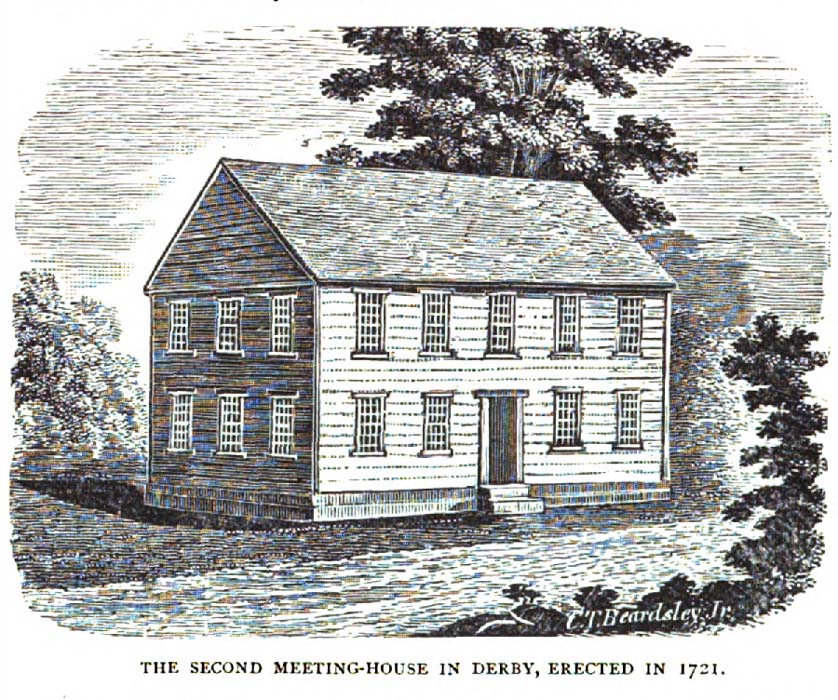
This meeting-house was built in the years 1721 and
1722, but it was not seated until after the
following vote: "Jan. 28, 1722-3, voted that the
meeting house shall be seated by such rules as
followeth: Col. Ebenezer Johnson, Ens. Samuel
Riggs and John Tibbals, Stephen
Pierson, Ens., shall sit in the first seat next
the pulpit; Doctor Durand, Mr. Samuel
Bowers and Jeremiah Johnson shall sit in
the second seat of the square next the pulpit;
John Pringle, Sergent Brinsmade, John
Chatfield, senre., shall sit in a short eat by
Mr. Moss' pew." At the same time it was
voted "we will seat all that remain according to the
list."
They had previously directed (Feb. 5, 1721-2) "that
Mr. Moss have liberty to build a pew six feet
square joining to the pulpit stairs, for his wife
and family."
Page 127 - EXEMPT
FROM RATES.
Page 128 -
THE NEGRO PEW.
"Again the town order the said committee to build a
convenient seat for the negroes on the beams over
the front gallery, and stairs to go up on the town's
charge."
The posts of that house were twenty feet high, which
gave room for a second gallery, or this seat "over
the front gallery."
These distinctions of class and caste were much, if not
wholly, indebted to slavery, for their existence.
At the first settlement and the beginning of the
first church, it was not so, but when slavery had
existed some yeasr, not only were the slaves reduced
to a position of degradation, but every other man
and his family in the community, not on the basis of
color, but that of money, they were seated in church
in accordance with the amount of money they were
worth or held in possession.
SABADAY HOUSES.
In 1725, the following record was made, showing
that the people began to think something about
comfort on Sunday or First Day, as then called, or
yet more strictly, it may be said that recorders
frequently wrote second day, third day, and fourth
day. "The town granted liberty to the
inhabitants to
Page 129 - FIRST
SCHOOL-HOUSE
THE LIST OF ESTATES
IN DERBY IN 1718, BY AUTHORITY OF THE TOWN.
|
Col. Eben Johnson |
£146 |
|
Capt. Joseph Hulls, |
226 |
|
Ens. Samuel Riggs, |
59 |
|
Abel Gunn, |
158 |
|
John Johnson |
33 |
|
Jabez Harger |
22 |
|
Ens. Samuel Nichols, |
60 |
|
Samuel Frinsmaid, |
15 |
|
Wm. Moss, |
98 |
|
Isaac Tomlinson, |
68 |
|
Abiram Canfield, |
23 |
|
Lef. John Riggs, |
160 |
|
John Hulls, |
69 |
|
|
Eben Harger |
£91 |
|
Mr. John Durand, |
55 |
|
Francis French, |
90 |
|
Jonathan Hill, |
21 |
|
George Black, |
21 |
|
John Munson, |
18 |
|
Andrew Smith, |
101 |
|
Jonathan Lum, |
54 |
|
John Davis |
54 |
|
Wm. Washbon, |
90 |
|
Saml. Moss, |
43 |
|
John Weed, |
56 |
|
Stephen Pierson, Jr. |
51 |
|
Page 130 -
|
Thomas Wooster, |
£117 |
|
Samuel Tomlinson |
62 |
|
William Tomlinson, |
39 |
|
John Twitchel, |
65 |
|
Abraham Tomlinson, |
29 |
|
Joseph Hawkins, |
137 |
|
Samuel Washbon, |
57 |
|
Timothy Wooster, |
78 |
|
John Pringle, |
57 |
|
John Tomlinson, |
51 |
|
Joseph Smith, |
31 |
|
John Smith, sen. |
82 |
|
Ephraim Smith, |
39 |
|
Ens. Eben Johnson, |
48 |
|
John Chatfield, |
87 |
|
Jeremiah Johnson, |
106 |
|
Benj. Styles, |
21 |
|
|
Stephen Pierson, sen., |
£52 |
|
John Tibbals, |
63 |
|
Joseph Nichols, |
32 |
|
John Towner, |
48 |
|
Samuel Bowers, |
59 |
|
Abraham Pierson, |
48 |
|
Abel Holbrook, |
86 |
|
Josiah Baldwin |
50 |
|
Joseph Johnson, |
28 |
|
Mr. Samuel Gunn, |
15 |
|
Mary Wooster, |
3 |
|
Samuel Bassett, |
28 |
|
Mr. Abraham Pinto, |
29 |
|
Peter Johnson, |
82 |
|
Micah Denman, |
31 |
|
James Humphreys |
18 |
|
ARRANGEMENTS OF
FENCE ON THE RIVER IN 1720.
Page 131 -
THE PROPRIETORS
OF SENTINEL HILL FIELD.
Page 132 -
Page 133 -
|