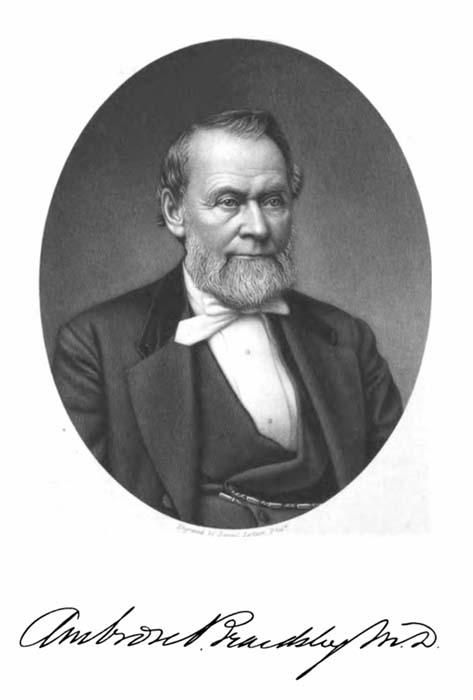
|
BIOGRAPHIES
The HISTORY of the
OLD
TOWN of DERBY,
CONNECTICUT
1642 - 1880
with
BIOGRAPHIES AND GENEALOGIES
By
Samuel Orcutt
Author of the Histories of Torrington and Wolcott, Conn.
AND
Ambrose Beardsley, M.D.
Published:
New York:
Press of Springfield Printing Company,
Springfield, Mass.
1880

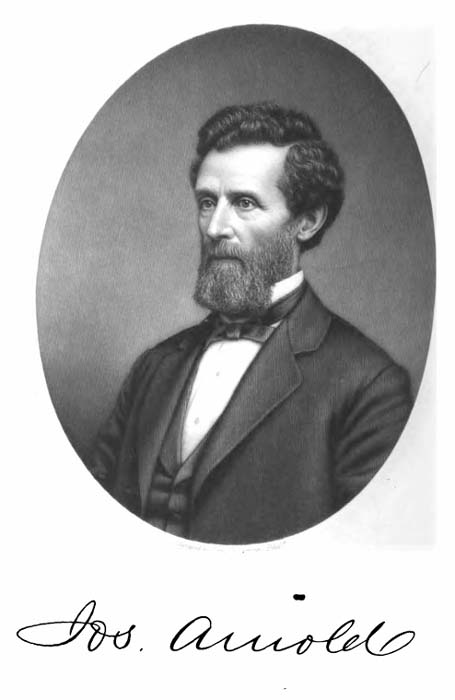
Jos. Arnold |
JOSEPH ARNOLD
was born at Hadham, Middlesex county, Conn., Sep. 16, 1811.
He descended from Joseph Arnold and Daniel
Brainard, two of the original twenty-eight who settled
the town of Haddam.
Joseph, the subject of this
sketch, was son of
Jared and Susan (Brainard) Arnold; received his education
at the common and high schools of his native town; made a
sea voyage with his father when only fourteen years of age;
was placed as clerk in a county store when fifteen, and at
nineteen opened a dry goods store in Middletown in company
with the old firm of Pease and Hayden. The next year
he bought out the other partners; took another partner, and
added the clothing business under the name of Arnold
and
Buckingham. Their business was highly
prosperous until 1838, when the partnership was dissolved,
Mr. Arnold remaining at the old store and Mr. Buckingham
going to Portland, Me.
Finding himself threatened with
serious pulmonary difficulty in 1844, Mr. Arnold
sold his business at Middletown and spent the next four
winters in the West Indies, the Southern states and New York
city.
His health being restored he
accepted a position in the American Exchange Bank, New York
city, but a few months after, being elected cashier of the
Meriden Bank at Meriden, Conn., he removed to that place in
1849. In 1853 he was elected cashier of the
Manufacturers' Bank of Birmingham, which was reorganized in
1865 as the Birmingham National Bank. This office he
accepted, and from that day to this has retained it with
great credit to himself and satisfaction to the company and
community.
In 1841 he married an estimable
lady,
Mary L., daughter of Hon. Noah A. Phelps.
She died in 1851.
Mr. Arnold may be
classed among the self-made men. Being little aided by
his primary education, but possessing an active, vigorous
mind, which he has well stored with useful knowledge by
reading, he has, by his own exertions, worked out thus far
his successful career in life. In addition to his
present responsible position in the bank he has occupied
others, such as treasurer of school district, borough and
town, and for a long time has been president of the Derby
Savings Bank, the people having never found him confidence
misplaced. In his habits he is a model for imitation.
Strictly temperate in all things, although physically
infirm, he has been his own physician, discarding generally
all drug medication. For twenty-six years he has
scarcely been absent a day from his post of duty in the
bank. Independent in his principles, circumspect in
his daily walk, liberal without ostentation, faithful to his
word in financial dealings with all persons, he has won for
himself a most enviable reputation.
(Source: History of the Old
Town of Derby, Connecticut, 1642 - 1880 with Biographies and
Genealogies by Samuel Orcutt & Ambrose Beardsley, M. D. -
Publ. Press of Springfield Printing Company, Springfield,
Mass. 1880.) |
| |
HENRY
ATWATER.
Was born in New Haven in 1819. He received more than an
ordinary education, and in 1846 came to Birmingham and bought
one-third of the interest of Abraham and William Hawkins
in the spring and axle business. In the following year a
joint stock company was formed, called the Birmingham Iron and
Steel Works, and the present extensive buildings were in part
then erected. Mr. Atwater continued an active and
energetic member of the company until the day of his death, Jan.
22, 1862, at the age of forty-three years. For sixteen
years Mr. Atwater was among the most enterprising
manufacturers, and had the merit of being very public spirited.
He never did things by halves.
He was warden of the borough two years; was postmaster
under President Pierce, Senator of the state in 1850,
besides filling other offices. Social and of gentlemanly
address, having considerable public influence, Mr. Atwater
was a popular citizen, and his death was deeply lamented.
Source: History of the Old Town of
Derby, Connecticut, 1642 - 1880 with Biographies and Genealogies
by Samuel Orcutt & Ambrose Beardsley, M. D. - Publ. Press of
Springfield Printing Company, Springfield, Mass. 1880 -
Page 524. |
| |
WILLIAM T. BACON
29
Was born in Woodbury Aug. 24, 1812; graduated at Yale aCollege
in 1837, at the Yale Theological Seminary in 1840, and was
ordained pastor in Trumbull, Conn., in 1841. He was
specially engaged in literary tastes, in addition to his
pastoral work, for several years, and in broken health retired
to the old Bacon homestead in Woodbury, from which
he came to Derby, settling first on a farm called "Hillside."
Afterwards, in view of occupation for his sons he established
the Derby Transcript, but his son James did not
long continue to enjoy the opportunities planned by a fond
parent, and his early decease has left a shadow on the household
that has beclouded specially all the joys of the father.
The Transcript is a stirring,
enterprising paper, which takes an honorable position among the
soaring, bird-like flock, which with stretching wings and eagle
eyes, hover over the Naugatuck valley. Mr. Bacon
also established, in connection with Thomas Woodward, the
New Haven Courier.
---------------
29 This and the following Biographies were
completed to late to be placed in alphabetical order with the
others.
Source: History of the Old Town of
Derby, Connecticut, 1642 - 1880 with Biographies and Genealogies
by Samuel Orcutt & Ambrose Beardsley, M. D. - Publ. Press of
Springfield Printing Company, Springfield, Mass. 1880 -
Page 676 |
| |
SCOTT R. BAKER, M. D.
was born in Derby, October 2, 1834 and obtained his early
education at the public school; later he studied medicine with
Doct. Ambrose Beardsley of Birmingham, and, entering the
medical department at Yale in 1876, he received his degree
January, 1879, and located at Ansonia where he promises to
secure a good practice.
Source: History of the Old
Town of Derby, Connecticut, 1642 - 1880 with Biographies and
Genealogies by Samuel Orcutt & Ambrose Beardsley, M. D. - Publ.
Press of Springfield Printing Company, Springfield, Mass.
1880 - Page 524 |
| |
LEONIDAS BRADLEY BALDWIN
Was born in New Haven, and fitted for college at the Hopkins
Grammar School in that city. He graduated at Trinity
College, Hartford, in 1860 and pursued his theological studies
at the Berkeley Divinity School, Middletown, Conn., and was
ordained to the priesthood by the late Bishop Chase of
New Hampshire, Birmingham in 1870, to the rectorship of
St. James's Church, which relation was terminated in November,
1879, to accept a call to St. Mark's Church, Boston, Mass.
Standing, as he did, fifteenth in the honored roll of
rectors of this ancient parish from Dr. Mansfield, his
rectorship was of longer continuance than any of the others.
Source: History of the Old Town of
Derby, Connecticut, 1642 - 1880 with Biographies and Genealogies
by Samuel Orcutt & Ambrose Beardsley, M. D. - Publ. Press of
Springfield Printing Company, Springfield, Mass. 1880 -
Page 676 |
| |
LEWIS
BARNES
Was born in Southington, Conn., June 26, 1826. He prepared
for college at home and was graduated at Yale in 1847; and
afterwards taught school at Bristol, Conn., and Brooklyn, N. Y.
He took a course of lectures at the College of Physicians and
Surgeons, in New York, and received his degree from the Buffalo
University in 1863. He came to Oxford in 1856, and has
been in active practice in his profession since that time; has
held the office of town treasurer two yeas, and since 1868 has
been town clerk and registrar; has been school visitor since
1857, and Judge of Probate since 1872. He married
Caroline Saltonstall of Meriden, Conn., in 1853.
Source: History of the Old Town of
Derby, Connecticut, 1642 - 1880 with Biographies and Genealogies
by Samuel Orcutt & Ambrose Beardsley, M. D. - Publ. Press of
Springfield Printing Company, Springfield, Mass. 1880 -
Page 858 |
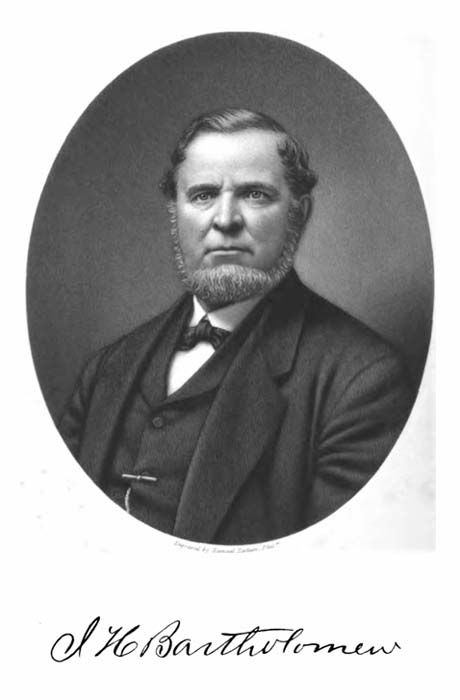
J. H. Bartholomew |
J.
H. BARTHOLOMEW
Was born in Farmington, Conn., Apr. 18, 1814. The life of
his father, Jonathan Bartholomew, sometimes called "Uncle
Jonathan," may be summed up in one line from Gray's
Elegy, "The short and simple annals of the poor." The
subject of this sketch had only a limited district school
education, and at the early age of fifteen he was employed by
Isaac Dobson to assist in making the double reflecting tin
baker, then in great demand, little thinking that this was
laying the foundation for his subsequent successful life.
The baker soon went out of use, but Mr. Bartholomew had
obtained a pretty good practical knowledge of the tinner's
trade, but being out of business he engaged one year as clerk in
a store in Plainville. In 1834 he married Polly H. Root,
the eldest of thirteen children. For a short time he was
employed in various kinds of work until he engaged in the making
of sheet-iron cow-bells at five cents an hour; the days having
fifteen or sixteen hours in those times, so that Old Time coming
in to help out the matter, his receipts were seventy-five and
eighty cents a day. Such was the beginning not only of one
but of many men in Connecticut who are now transacting business
on the basis of millions a year.
Mr. Bartholomew next engaged in making
brass kettles for Mr. Israel Coe of
Wolcottville, Conn., and by his steady business habits, after
four years’ employment, was made superintendent of all the
various manufacturing interests of the Çoe Company, the
most important of which was the making of brass kettles by what
was called the “battery process.’ When this business began to be
profitable a new method of making these kettles was introduced
into the country and the business was engaged in by different
companies. At this time Anson G. Phelps, then a
large stockowner in the Wolcottville Company, was induced to
start the business on a larger scale, and decided on Ansonia as
the place of location, and he secured Mr. Bartholomew
as the place of location, and he secured Mr. Bartholomew
as the general agent of his company. Several manufacturing
establishments were built in Ansonia under his supervision,
viz., the "Battery and Rolling Mills," and the large "Brass and
Copper Mills." Besides these, from time to time, numerous
other branches were added, all of which proved successful except
the "Battery Kettle" business, which was supplanted by the new
process.
These various branches of industry which have added so
much to the wealth of Ansonia, as well as to the stockholders,
are largely under obligation to the efforts of Mr.
Bartholomew; and, an idea of the estimate placed upon his
services may be gained from the fact that a large yearly salary
was paid him for more than a quarter of a century.
In 1869 Phelps, Dodge and Company merged all
their extensive manufacturing interests in Ansonia with their
real estate into one company under the name and firm of the
"Ansonia Brass and Copper Company and the Ansonia Land and Water
Power." At the first meeting of the joint companies Mr.
Bartholomew was chosen a director and made general
superintendent, which office he held up to 1876, when he
resigned in consequence of ill health. His advent into
Derby, in 1848, found Ansonia almost a barren, sandy plain, with
only two factories and a very few dwelling houses. Among
the first enterprises started was a good common school, in which
he took an active part and was instrumental in doing away with
the old rate bill system and establishing the method of support
by taxing property only, which incensed the mind of Anson G.
Phelps, this being the first school in the town to adopt the
method, but the excitement soon subsided.
He took a lively interest in the formation of the
Congregational Society of Ansonia, and in building both its
churches, the first having been accidentally burned. He
led the church choir over twenty years, and was chairman of the
society's committee about the same length of time. He was
a stockholder, director and president of no less than six
important moneyed institutions of the town, and served, so far
as can be learned, to the acceptance of the parties interested.
Mr. Bartholomew was the first to propose the
extension of the New Haven and Derby railroad, from its junction
with the Naugatuck road, to Birmingham and Ansonia, and secured
its completion by most persistent efforts; the result being a
great reduction of freights and public convenience.
He is a man of positive character, and being a
republican in politics was elected to represent the town in the
Legislature of 1869, receiving votes from both parties. He
was a vigorous supporter of the war for the Union, contributing
liberally of his means.
thus the poor boy of Farmington became an active,
useful pioneer in a variety of successful enterprises in the
town, and his name will long be held in grateful remembrance,
especially by the people of Ansonia. His example is worthy
of imitation.
Source:
History of the Old Town of Derby, Connecticut, 1642 - 1880
with Biographies and Genealogies by Samuel Orcutt & Ambrose
Beardsley, M. D. - Publ. Press of Springfield Printing
Company, Springfield, Mass. 1880 - Page
525 |
| |
REV.
AMOS BASSETT, D. D.,
Was born in Derby (the son of Dea. Amos Bassett of Great
Hill Society); graduated at Yale College in 1784; licensed to
preach by the New Haven West Association in 1792; was pastor at
Hebron, Conn., from 1794 to 1824; preached at Monroe, Conn.,
afterwards, and died in 1828. He succeeded Mr. Daggett
in 1824 as principal in the Cornwall Mission School. He
was a member of the corporation of Yale College from 1810 to his
decease. "He was an excellent scholar, a sensible and
solemn preacher, and especially distinguished for the gravity of
his deportment and for godly simplicity and sincerity."
Source:
History of the Old Town of Derby, Connecticut, 1642 - 1880
with Biographies and Genealogies by Samuel Orcutt & Ambrose
Beardsley, M. D. - Publ. Press of Springfield Printing
Company, Springfield, Mass. 1880 - Page
676 |
| |
REV. ARCHIBALD BASSETT
Was born in Derby, Mar. 21, 1772; graduated at Yale College in
1796; ordained pastor of the Congregational Church at
Winchester, Conn., May 20, 1801, and dismissed August, 1806.
He was pastor at Wilton, Delaware county, N. Y., from 1807 to
1810, and resided in that place, preaching in that region and
helping his brethren in revivals as opportunity afforded, until
his death, Apr. 29, 1859, aged eighty-seven years. He was
the son of Benjamin Bassett.
He married Eliza, daughter of Dea. Job and
Eunice (Cowles) Curtiss of Torringford, in the town of
Torrington, Conn. She died Jan. 19, 1868.
Source:
History of the Old Town of Derby, Connecticut, 1642 - 1880
with Biographies and Genealogies by Samuel Orcutt & Ambrose
Beardsley, M. D. - Publ. Press of Springfield Printing
Company, Springfield, Mass. 1880 - Page
528 |
| |
BENJAMIN
BASSETT, M. D.,
Son of John and Nancy A. (Lee) Bassett, was born in
Derby, Jan. 23, 1827; graduated at Yale College in 1847;
received the degree of M. D. at Yale College in 1851. He
practiced medicine a time in Brooklyn, when failing in health he
removed to New Haven in 1874, where he died in 1879.
Source:
History of the Old Town of Derby, Connecticut, 1642 - 1880
with Biographies and Genealogies by Samuel Orcutt & Ambrose
Beardsley, M. D. - Publ. Press of Springfield Printing
Company, Springfield, Mass. 1880 - Page
676 |
| |
EBENEZER
D. BASSETT
Was born in Litchfield, Conn., Oct. 16, 1833, and came to Derby
when an infant, so that he is essentially a Derby citizen.
His early education was very meagre, and while an office boy for
Doct. A. Beardsley he developed talents that courted
encouragement. He attended the High School in Birmingham,
then went to the academy at Wilbraham, Mass.; graduated at the
State Normal School in 1853; studied at Yale in 1854 and 1855,
obtaining a good knowledge of the classics. He then
devoted himself to teaching, continuing for sixteen years.
If his skin was not white he was a good scholar and excelled in
mathematics. During the war he wrote many appears, which
appeared in the newspapers, to encourage the enlistment of
colored soldiers. He has been minister to Hayti eight
years, and is now stationed in New York city as consulate of the
United States to Hayti, for which position he is largely
indebted to Col. William B. Wooster and others of
Birmingham, who encouraged and furnished him means to press
forward in his ambition. In a note he makes the following
acknowledgement: "My success in life I owe greatly to that
American sense of fairness which was tendered me in old Derby
and which exacts that every man, whether white or black, shall
have a fair chance to run his race in life and make the most of
himself."
Source:
History of the Old Town of Derby, Connecticut, 1642 - 1880
with Biographies and Genealogies by Samuel Orcutt & Ambrose
Beardsley, M. D. - Publ. Press of Springfield Printing
Company, Springfield, Mass. 1880 - Page
Page 676-77 |
| |
DOCT.
MARTIN BULL BASSETT
Was born in Hebron May 14, 1802, being the son of Rev. Amos
Bassett, D. D.; was fitted for college by his father;
graduated at Yale College in 1823; studied medicine with Doct.
Isaac Jennings of Derby, attending also Yale Medical
College. He married Caroline Tomlinson of
Huntington, Conn., and went to Ohio, practicing medicine only a
short time owing to delicate health. Returning East, and
inheriting a large farm near Birmingham, with other property, he
spent his life in agricultural pursuits. He died May 15,
179, aged 77.
Source:
History of the Old Town of Derby, Connecticut, 1642 - 1880
with Biographies and Genealogies by Samuel Orcutt & Ambrose
Beardsley, M. D. - Publ. Press of Springfield Printing
Company, Springfield, Mass. 1880 - Page
678 |
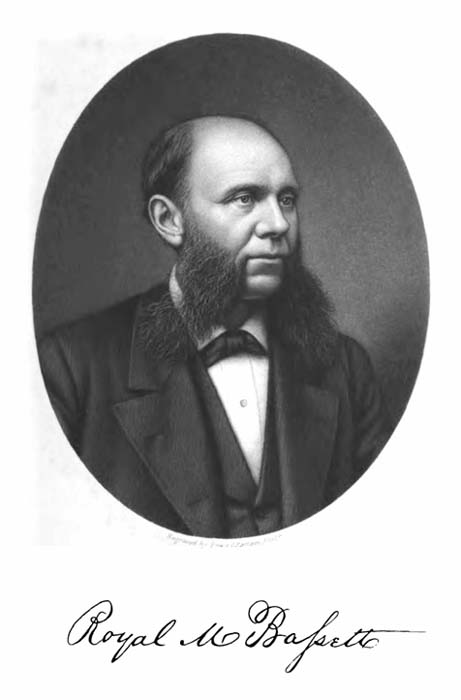
Royal M. Bassett |
ROYAL
M. BASSETT
Was born in Derby Nov. 22, 1828. His education was
obtained in the district school, except one year in the academic
school of Stiles and French in New Haven and two years at Haddam
Academy. His father was one of the leading men of Derby
and a pioneer in the business enterprises of Birmingham; first a
merchant and then a manufacturer. He held many official
positions with honor, but after the purchase of the Colburns
Iron Foundry in 1850, he devoted all his energies to his
business until the day of his decease, which occurred June 26,
1864, in his sixtieth year. On the decease of his father,
Royal M., with his brother Theodore, managed the
Iron Foundry with much success, giving steady employment to
about 125 operatives for sixteen years, making it a valuable
establishment to Birmingham.
Royal M. Bassett has been engaged in various
manufacturing enterprises, railroads, and real estate
operations, during a quarter of a century, and is a director in
three railroad companies at the present time and president of
the Utah Northern railroad. He has been warden of the
borough two years, and an active and efficient committee-man of
the Birmingham school district for eleven years, besides filling
several other local positions, which places him among the public
spirited men of the village and town. In all which he has
proved himself a thorough business and upright man.
Social, affable and liberal, and willing to forward any needed
work for the public good, he stands among the popular and
influential citizens of the town. He represented the fifth
senatorial district in the Legislature, in 1876.
Source:
History of the Old Town of Derby, Connecticut, 1642 - 1880
with Biographies and Genealogies by Samuel Orcutt & Ambrose
Beardsley, M. D. - Publ. Press of Springfield Printing
Company, Springfield, Mass. 1880 - Page
528 |
| |
REV. WILLIAM ELLIOTT BASSETT
Son of John and Nancy A. (Lee) Bassett, was born in
Derby, May 24, 1829; graduated at Yale College in 1850; studied
theology in Union Theological Seminary, in New York, and in the
Divinity School, New Haven, and was ordained pastor of the
Congregational church of Central Village, Conn., Feb. 14, 1856.
He became acting pastor in North Manchester, Conn., January,
1860, and was installed pastor at Warren, Conn., Oct. 12, 1864.
His residence was in New Haven from 1876 to 1879, and on May 1,
1880, he became acting pastor in Bethlehem, Conn.
Source:
History of the Old Town of Derby, Connecticut, 1642 - 1880
with Biographies and Genealogies by Samuel Orcutt & Ambrose
Beardsley, M. D. - Publ. Press of Springfield Printing
Company, Springfield, Mass. 1880 - Page
678 |
| |
REV.
BENJAMIN BEACH,
Son of Benjamin Beach, sen., of North Haven, was
born Aprl. 15, 1737, and resided at North Haven some years in a
house his father built in the year Benjamin jun. was
born; his two brothers residing one on each side of him, and in
the three families were at one time seventeen sons. His
brother, Elias Beach, was a farmer and a licensed
preacher, but not ordained.
Benjamin Beach preached in what is now Seymour,
Prospect and Milton. Tradition in the family says, he
having agreed to settle in Seymour waited all winter for snow on
which to remove his family, but the snow failed to come that
winter and he removed in March, 1789, without snow. In
November of this same year Isaac Johnson deeded to Mr.
Beach "one acre of land lying a little east of the
meeting-house," which was a present to Mr. Beach in
consideration of his "settling in the gospel ministry in the
Congregational or Independent church" in the place. On
this land Mr. Beach built a house in which he resided,
and which is still standing. In 1791 he bought of
Isaac Johnson one acre and a half adjoining, and "lying east and
south of the first." In 1799 he purchased of Amos
Hine seventeen acres for $333 at the place called Success
Hill, and on Feb. 26, 1810, being then of Cornwall, he sold to
John Swift eighteen acres of land at Success Hill for
$686.06.
The meeting-house was built for his
use and was standing when he received the first deed. He
preached in Prospect several years, closing his labors there in
1797, and probably served the two churches at the same time.
He is said to have removed to Cornwall about 1805, which gives
him eighteen years of ministerial labor in Seymour.
He married Mercy Blatchley, who died in 1812 on
her seventy-fifth birthday, and he died in Cornwell July 12,
1816, aged seventy-nine years.
Two sermons of Mr. Beach are preserved, and are
in the style of the age in which he labored, and compare
favorably with hundreds of others by different ministers of that
day. One of these sermons illustrates the old method of
giving instruction from a text in a very clear manner.
Many have laughed at the great number of divisions the older
preachers mentioned in their sermons, but those divisions
frequently marked not a division of the subject treated, but
simply the thought illustrative of the topic spoken of; as in
this sermon there are only three heads, or general propositions,
and the advice given; but during the discussion of the topics
there are in all eighty items numbered with figures. Hence
there is secured in such a production a great amount was
delivered, all knew precisely what the minister believed, which
is not always the case at the present time. The old people
who delighted in such preaching are frequently supposed to have
been dull scholars and poor thinkers, but it is quite certain
they did know what they believed, and why they believed it.
Source:
History of the Old Town of Derby, Connecticut, 1642 - 1880
with Biographies and Genealogies by Samuel Orcutt & Ambrose
Beardsley, M. D. - Publ. Press of Springfield Printing
Company, Springfield, Mass. 1880 - Page
532 |
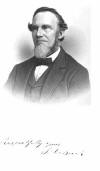
S. Y. Beach |
SHARON
YALE BEACH.
Son of Giles and Mary (Dayton) Beach, was born May 21,
1809, in that part of North Haven, Conn., now called Montowese,
near Pine River Bridge. Giles Beach was the second
son of the Rev. Benjamin Beach, the first pastor of
Chusetown.
Mary Dayton, the wife of Giles Beach, was
the daughter of Jonathan Dayton and Mary Yale of
North Haven. Jonathan Dayton had several children,
one of whom married Joel Thorp, who removed with his
family from North Haven by means of an ox team to New
Connecticut (Ohio) and was one of the pioneers in that section
of the country; his nearest neighbor being twelve miles distant.
This Jonathan Dayton was a captain in the Revolution and
had four of his sons under him in the army, which gave to his
command the name of the Dayton company. He was also a
justice of the peace and a prominent man in his community.
Sharon Y. Beach had only the advantages of a
common school education, although one of his teachers,
Benjamin Eastman, grandson of Dr. Benjamin Trumbull
himself a liberally educated man, thinking young Beach
ought to have better opportunities, offered to furnish them at a
higher school; but the spirit of independence declined the
friendly offer while the kindness of the teacher was always
gratefully remembered.
His early life was one of temperance, industry and
frugality; laboring on a farm until he was seventeen years of
age, when he passed through a long siege of ill ness from which
he recovered very slowly. After this, he at first engaged
as a peddler, carrying his small stock of goods in a basket and
hand trunk, and then accepted a place as a clerk in a dry goods
and grocery store where he continued until his employer sold his
interests to another firm. After a few months he was
employed by John H. De Forest in the cotton factory, then
in operation at Humphreysville, for the small sum of $16 per
months for the first year, and $18 per month for the second,
with the promise of an increase of wages or a more advantageous
position at the expiration of that time. From this amount
of wages he paid his board, clothed himself and saved a small
sum for capital on a future day.
At the expiration of his engagement the business of the
factory was so depressed as not to warrant his continuance in
which he said: "I recommend him to any one in want of his
services as one competent and faithful, and whose character is
entirely above reproach." The terms of this confidence
exceeded the expectations of Mr. Beach, but they gave him
an inward courage which has never been effaced from his mind;
which fact illustrates that a little expression of confidence is
often of more value than money. After six months'
employment elsewhere he was again employed by Mr. DeForest
in the cotton factory, at advanced wages, where he continued
nine or ten years.
In the year 1843, he in company with George L. Hodge
and Samuel Roselle engaged in the manufacture of printing
and colored paper, in which relation he continued two years,
when a new company was formed, consisting of Ezekiel Gilbert,
Samuel Roselle and himself, for the term of five years.
This company purchased the old mill standing on what was still
known at that day as Rimmon Falls, and continued the paper
making business. At the expiration of that term Mr.
Beach bought the interests of the other partners and removed
the paper mill to its present location, about three -quarters of
a mile east of Seymour on Bladen's brook, where he has continued
to the present time with a good degree of success.
Mr. Beach has occupied several positions of
trust and honor in the town, and manifested considerable public
spirit in the more substantial enterprises and progressive
improvements of the community and town. He was elected to
the office of justice of the peace while Seymour belonged to
Derby, and after its separate organization he was the justice
before whom most of the cases were tried for several years.
Upon the breaking out of the war of the Rebellion he was the
first to offer a bounty to those who would enlist in the army
for the defense of the Union, and paid to those who enlisted in
the twentieth regiment, ten dollars each, to the amount of $270,
and continued in an active part in sustaining the town in all
its efforts through that struggle. He has been selectman,
a member of the board of relief, a member and chairman of the
board of education a number of years.
He has been a member of a Baptist church about fifty
years; has had charge of the Congregational Sunday-school in
Seymour at several different terms, and when the Baptist Bible
school was started at Ansonia he was elected its superintendent,
which position he held about six years. He was one of the
building committee of the Ansonia Baptist church; was elected
its first deacon, and has been a prominent member and an active
supporter of that church since its organization, there being no
Baptist church in Seymour.
In business and principles of morality, he has made
life a success, and has no reason to reflect severely upon it as
it recedes into the forgetfulness of the past.
Mr. Beach married first Adaline, daughter
of Asa and Eunice (Johnson) Sperry, of Orange, Conn., and
they had eight children, five of whom are still living.
The eldest, George W. Beach, is the superintendent of the
Naugatuck railroad. (Which see.) Andrew Y. Beach
is agent at Springfield (Mass.) of the N. Y., N. H. & H.
railroad. Sharon D. Beach has charge of his
father's paper mill. Theodore B. Beach is the agent
of the Naugatuck railroad at Seymour. Emeline E. Beach,
the only daughter, resides with her father.
Source:
History of the Old Town of Derby, Connecticut, 1642 - 1880
with Biographies and Genealogies by Samuel Orcutt & Ambrose
Beardsley, M. D. - Publ. Press of Springfield Printing
Company, Springfield, Mass. 1880 - Page
533 |
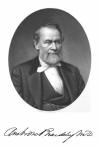
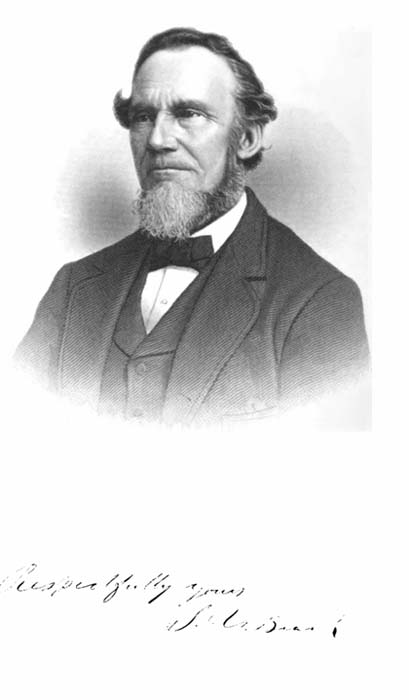
Ambros Beardsley, M.D. |
AMBROSE
BEARDSLEY, M. D. 1
Doct. Ambrose Beardsley, whose portrait is the
first in this book, was born in Monroe, Conn., Oct. 23, 1811.
It is often said "the child is father to the man," the which if
true, the young Ambrose must have been one of those kind
of boys who according to the Sunday-school books ought to have
"died early," but fortunately for mankind did not. His
first appearance in public was in the role of a district school
teacher beginning at the age of sixteen years; continuing four
years in his own and adjoining towns, during which time he
pursued assiduously his own studies under the instruction of
Doct. Stephen Middlebrook, of Monroe and later
under Doct. Charles Gorham of Redding, and finally
graduating with honor at Pittsfield, Mass., Medical College in
1834. After a residence of a year and a half at Newtown,
Conn., Doct. Beardsley came to Birmingham, then in its
early infancy, where for forty-four years - nearly half a
century - he has led an honorable, upright, and eminently useful
Christian life; often officiating at St. James's Episcopal
Church - of which parish he has been a life-long member - in the
occasional absence of a pastor, as "lay reader." If Ben
Adhem's name led all the rest, according to Leigh Hunt,
because "He loved his fellow men," then surely must the name of
this kind, self-sacrificing physician be found very near the
head of the column of Derby's adopted sons. In hundreds of
families in this and adjoining towns, the name of Ambrose
Beardsley is cherished almost as a house hold god; where his
genial face and pleasant story, has often done the work of
exorcising the demon of disease - real or imaginary - for which
the harmless pill gets all the credit.
Possessed of a clear ringing voice, great fluency of
speech and a happy gift of oratory, upon all public occasions
Doct. Beardsley has been "the speaker of the day" and
conspicuously the figurehead and leader in all enterprises which
had for an object the welfare of nation or of individuals.
Before the writer is now lying an ancient looking document which
bears the following statement: "The foregoing oration was
delivered by A. Beardsley, to the citizens of Derby on
occasion of commemorating the anniversary of our American
Independence, July 4, 1839." As a sample of the principles
then held by the orator a quotation is important: "Sacred
to the heart of every true American should be the day we have
here assembled to commemorate. We have met to join in
congratulations over an event so abundantly propitious to this
country, and so marked in its influence upon the world that as
patriots and loyal citizens we could not have met on this
occasion with other feelings than those of gratitude, and an
ardent love and desire to preserve in remembrance the birthday
of our National Independence; coupled with a determination to
throw off for a moment our more common attachments; to mingle
our hearts more completely in the ardor of freedom; to manifest
our zeal for the preservation of our dear bought liberties;
and to join in the celebration of the day in a way calculated
not only to awaken in our minds anticipations of the noblest
destiny, but to call up those master spirits of the past who
offered their all upon the altar of Liberty." Farther
along we read as follows: "The founders of this republic have
not set in motion a machine which will continue to run uniform
without the constant care and vigilance of posterity . . . . .
The history of the past speaks to us in tones of thunder the
fact that one of the strongest and most sacred of the
obligations imposed upon us by our fathers is the maintenance
and perpetuity of the bond of the Union. I repeat it with
emphasis, Union between the states. The Moslem Turk
sleeps soundly in his chains not even seeming to dream of their
weight. The slave surrenders himself tamely to his master,
but the hatred of party dissensions and political animosities
should never lead to a calculation on the value of the
Union. 'One Europe' says an eloquent patriot 'is enough
for the whole world,' and if Americans would not hear the
shrieks of Liberty, if they would not see this fair Republic
'rent with civil feuds and drenched in fraternal blood,' let
them be forever deterred from indulging even a passing thought
upon the dangerous doctrine of disunion." This be it
remembered was the utterance of our "Fourth of July orator"
forty-one years ago. In the light of the terrible events
of a quarter of a century later, it is seen that had the mouth
of a prophet of the Lord even been commissioned to speak
an inspired warning it could have hardly been more pertinent and
forcible.
The oration, which is full of the various topics
uppermost in those comparatively early days of the Republic,
closes with the following peroration: "Let us, fellow citizens,
at all times and in all places prove ourselves the undeviating
friends of our country, by sustaining its wise government,
promoting sound doctrine, advancing whole some morality and pure
religion." But scarcely a quarter of a century had passed
when we find this watchman on our national walls sending his own
first born to the field in defense of these vary liberties
imperiled by intestine feuds, and himself laboring day and night
in furnishing comforts and necessities for the sick and the
wounded soldiers in the field. In June, 1864, by all
odds the largest and most successful fair ever held in the town
was held on Birmingham green under an immense tent, and which
resulted in raising over $4,000 in aid of the Sanitary
Commission, which enterprise was largely indebted for its
success to the unflagging efforts of Doct. Beardsley and
the several members of his family who took part in the
enterprise of other noble workers took part in the labors of the
occasion.
In political life the Doctor was well fitted to do
noble work.. Although never a member of the noble army of
Connecticut legislators yet many a time the honor was within his
easy reach had he chosen to avail himself of his opportunity.
His always extensive professional practice forbade his
acceptance of the position. In the town, however, he has
been a public official in some important capacity nearly all the
time of his residence here. For twenty-five years
continuously he was town treasurer; eight years he has been
warden of Birmingham, and registrar of vital statistics the same
length of time, besides many other minor offices much of the
time. The Doctor, though now verging well towards three
score and ten, is vigorous and full of energy; ever ready at all
times to respond to the calls of the sick, whether with prospect
of remuneration or not, it seems to make little difference with
him. Little indeed has he gathered of the gold that
perisheth, but of the wealth that cometh from the living of an
earnest, friendly, humane life, he is the richest man in all the
town. It is here clearly put on record that these words
will be abundantly verified when his record shall be closed.
He married Mary, only daughter of Samuel
Bassett, Esq., of Humphreysville, Apr. 30, 1837.
J. W. S.
---------------
1 This sketch was written by him whose
initials are at the end of it.
Source:
History of the Old Town of Derby, Connecticut, 1642 - 1880
with Biographies and Genealogies by Samuel Orcutt & Ambrose
Beardsley, M. D. - Publ. Press of Springfield Printing
Company, Springfield, Mass. 1880 - Page
528 |
| |
GEORGE LUCAS BEARDSLEY, M.
D.,
Was born in Milford, Conn., May 12, 1848, where he attended the
High School some time. He prepared for college at the
Hopkins Grammar School in New Haven, entered Yale in 1866, and
was graduated in 1870. He was graduated at the Bellevue
Hospital Medical College, New York, in 1873, and received his
degree of M. D. He came to Birmingham in 1874; has been a
member of the Board of Education, and is at present assistant
surgeon of the 2nd regiment Connecticut National Guards.
He married, M. Louise, daughter of Amos H. Alling,
Esq., Dec. 24, 1874.
Source:
History of the Old Town of Derby, Connecticut, 1642 - 1880
with Biographies and Genealogies by Samuel Orcutt & Ambrose
Beardsley, M. D. - Publ. Press of Springfield Printing
Company, Springfield, Mass. 1880 - Page
531 |
| |
THADDEUS
G. BIRDSEYE
Was born in Huntington, Sept. 9, 1812, and came to Birmingham in
the spring of of 1836, where he engaged in mercantile
business with his brother Ephraim, several years on Main
street. He was postmaster six years after Henry Atwater
resigned; was town clerk four years, and has been secretary and
treasurer of the Derby Savings Bank for the last twenty years.
He has filled all these offices with great credit and
satisfaction to the public, especially the last mentioned.
Source:
History of the Old Town of Derby, Connecticut, 1642 - 1880
with Biographies and Genealogies by Samuel Orcutt & Ambrose
Beardsley, M. D. - Publ. Press of Springfield Printing
Company, Springfield, Mass. 1880 - Page 678 |
| |
ALFRED BLACKMAN
Was born in Newtown, Conn., Dec. 28, 1807. His father, the
late Samuel C. Blackman, was a graduate of Yale College,
class 1793, and was judge of probate for the district of Newtown
from its organization until disqualified by the state
constitution, which was about fifteen years, and died at the
advanced age of ninety-one.
Alfred studied the classics and
was fitted for college by his father, and graduated at Yale in
1828. He read law in his father's office, reciting
regularly for two years to the late Gov. Henry Dutton,
and was admitted to the bar of Fairfield county in 1831.
The writer of this remembers well listening in that same year,
with great pleasure, to an eloquent oration delivered by him at
Monroe, on the occasion of the celebration of the Fourth of
July.
In the spring of 1832 he removed to Humphreysville,
then a flourishing part of Derby, and commenced the practice of
his profession. At this time Horace M. Shepard,
also from Newtown, was practicing law in that village, where he
had been settled two or three years, but removed in a few weeks,
and soon after died.
Mr. Blackman married on the 3d of June, 1832,
Abby Beers, of his native town, and had two sons born at
Humphreysville, both of whom graduated at Yale, the eldest,
Samuel C., in the class of 1854, and Charles S., in
the class of 1857. Three generations of this family were
present as graduates at a meeting of the alumni of this college
at one of its commencements.
Mr. Blackman remained at Humphreysville ten
years, encouraged by an increased and flattering practice, until
he was elected to the state Senate from the firth district.
At the end of the session of the Legislature he removed to
Waterbury to take charge of the probate office of that district,
and in consequence of the sickness and lamented death of
Judge Robinson S. Merriman he was called to take charge of
the probate court of New Haven, thus dividing his time between
the two districts. This led him to remove his law office
to New Haven, where he has since resided. In 1855 he was
elected as one of the representatives from New Haven, his
colleague being ex-Gov. James E. English. While a
member of the Legislature he was elected mayor of New Haven and
served in that office one year, declining a re-nomination, and
refusing ever since to be a candidate for election to any
political office. He was elected for one year by the
Legislature judge of the county court, and on hearing of his
appointment immediately sent his written declination of the same
to the Hon. Origin S. Seymour, speaker of the House, who
assumed the responsibility of not presenting it to that body,
and he was persuaded to fill the office one year, although he
preferred the office of an advocate to any position or other
employment. But he did consent, under the appointment of
the late Andrew T. Judson, judge of the United States
district court, to accept the office of clerk of that court and
of the circuit court of the United States, which appointment was
continued by the late Judge Charles A. Ingersoll and
William D. Shipman, and he held these offices from 1852 to
1867, when Judge Loren P. Waldo was appointed his
successor, and the office and records were then removed to
Hartford.
Since his retirement from the active practice of his
profession in 1872, in consequence of impaired health, he has
been occupied most of the time in his private library, in
miscellaneous reading, and receiving the social calls of his
friends and taking a daily drive in seasonable weather.
His brethren of the New Haven county bar have caused his
portrait to be painted, of life size in oil, and suspended in
the superior court room, attached to which, in a frame, is a
copy of the correspondence which explains itself. As it is
of appropriate character it is given a place in these pages, and
is as follows:
NEW HAVEN, November, 9, 1878.
Hon. Alfred Blackman:
Dear Sir - Desiring to express in some
suitable manner our personal regard for you, and in recognition
of the distinguished position you have held at the bar of this
state, and also your services in securing the erection of our
new court house, we have placed your portrait in the superior
court room. We trust our election in this respect will be
agreeable to you and gratifying to your numerous friends.
Very sincerely your friends and brethren at the bar,
John
S. Beach,
C. R. Ingersoll,
H. B. Harrison,
T. E. Doolittle,
J. W. Webster,
Luzon B. Morris,
Simeon E. Baldwin, |
George H. Watrous,
D. R. Wright,
Charles Ives,
Francis Wayland,
Arthur D. Osborne,
Louis H. Bristol,
Samuel L. Bronson |
NEW HAVEN, January, 1879
To Messrs. John S. Beach,
Charles R. Ingersoll, Arthur D. Osborne, and others, members
of the New Haven county bar:
Gentlemen - Your esteemed favor informing me of your action
in procuring my portrait to be painted and placed in the
superior court room was recently received, and impressed my
heart with war and abiding gratitude. You may be assured
that such an unmerited act of kindness is agreeable to me and
commands my cordial approbation.
To be associated with the portraits of the learned and
acute Baldwin, the eloquent and amiable Ingersoll,
and the noble hearted and generous Foster, in the arena
of their forensic exploits, and in the building which you are so
kind as to say I contributed some service in securing its
erection, is gratifying to my ardent professional ambition. We
belong my friends, to a somewhat belligerent profession; and if,
after nearly a half century of intimate association and conflict
with my brethren. I have so far succeeded as to be
entitled to this ante mortem token of your esteem and the
generous words you so kindly express, you will believe me when I
say that I am now and ever shall be. with sincere gratitude,
Your affectionate friend and
brother,
ALFRED BLACKMAN
Fixed
in his principles, Judge Blackman seldom entered the
arena of politics, oftener rejecting than accepting the tender
of political honors, choosing rather to confine himself to the
duties of his profession. Affable and gentlemanly in his
manners, blessed with a classical education, shrewd and
clear-sighted in his capacities, a ready and pleasing speaker,
he has won for himself a reputation that enrolls his name among
the first members of the New Haven bar. - Since writing the
above Mr. Blackman has died, having passed away Apr. 28,
1880.
Source:
History of the Old Town of Derby, Connecticut, 1642 - 1880
with Biographies and Genealogies by Samuel Orcutt & Ambrose
Beardsley, M. D. - Publ. Press of Springfield Printing
Company, Springfield, Mass. 1880 - Page 536 |
| |
FREDERICK P. BLODGETT, M. D.
Was born at Broad Brook, Conn., Jan. 6, 1847. His early
school days were passed at the public schools, and Ellington
Academy from which he graduated, and entering Yale Medical
College in 1868, was graduated at that institution in 1871,
receiving the degree M. D. He has practiced his profession
in Ansonia since 1871, with the exception of three years.
Although a young man, Dr. Blodgett has gained a large and
remunerative practice, of which many an older physician might
well feel proud. The only public office held during his
residence in Ansonia is that of registrar of vital statistics
which position he held two years.
Source:
History of the Old Town of Derby, Connecticut, 1642 - 1880
with Biographies and Genealogies by Samuel Orcutt & Ambrose
Beardsley, M. D. - Publ. Press of Springfield Printing
Company, Springfield, Mass. 1880 - Page 539 |
| |
REV. JOHN BOWERS
Was a native of England, the son of George Bowers who was
in Scituate, Mass., in 1637, in Plymouth in 1639, removed to
Cambridge where his wife was buried Mar. 25, 1644. John
was graduated at Harvard College in 16491, and
was a schoolmaster in Plymouth, perhaps (says Savage) the
earliest in the business. He came to New Haven in the
spring of 1653 to teach, which he did some years. We hear
of him next in Guilford, where in 1660, he purchased an estate
and supplied the pulpit for three or four years until
Mr. Joseph Elliot was settled in 1664.
On the removal of Abraham Pierson with other
planters from Branford in 1667, Mr. Pierson engaged
Mr. Bowers to supply his place until the end of the year.
After this as Rev. T. P. Gillett of Branford
informs, "Mr. Bowers received an invitation to settle
with the people although no church was organized. He
remained until February, 1672, and then gave the town liberty to
provide a minister for themselves, which they accepted."
In November, 1673, he was preaching regularly in Derby and the
people made provision to build him a house, in which he
afterwards resided. In the spring of 1671, Derby granted
him twelve acres of land and he had probably preached here some
at that time, and was here during most of the year 1673.
For his salary during 1674 he agreed to take what the people
were willing to give, and after that for some years he received
fifty pounds a year.
In 1684 he was very sick and made a will which was
recorded by the town clerk. He probably died on the 14th
of June, 1687, and yet it is unaccountable how it should occur
that the town clerk should have recorded the death of a minister
without writing Mr. to his name as in this case. I
do not remember to have seen a minister's name written before
the Revolution without the "Mr." attached.
He married at New Haven, Bridget daughter of Anthony2
Thompson of New Haven, who survived him until May 19,
1720.
---------------
1 American Quarterly Register viii.
335.
Source:
History of the Old Town of Derby, Connecticut, 1642 - 1880
with Biographies and Genealogies by Samuel Orcutt & Ambrose
Beardsley, M. D. - Publ. Press of Springfield Printing
Company, Springfield, Mass. 1880 - Page 539 |
| |
REV.
JOHN BRAINARD.
Was born in Hartford, Conn,, June 4, 1830, was fitted for
college at the Hartford Grammar school and Cheshire Academy, was
graduated at Trinity College in 1851, pursued his theological
course at the Berkley Divinity school, and was ordained deacon
by Bishop Brownell Dec. 18, 1853.
He was assistant minister at Grace Church at Baltimore
for two years and ordained priest by Bishop Whittingham
May 28, 1856. He was called to the rectorship of St.
James's Church of Birmingham in 1856, where he remained until
November, 1863, when he resigned to accept the rectorship of St.
Peter's Church at Auburn, N. Y.
Mr. Brainard was a very acceptable, exemplary
and efficient pastor and his resignation was much regretted by
the parish. In 1870 he received the degree of S. T. D.,
from Trinity College, Hartford, and is at present rector of St.
Peter's Church, Auburn.
Source:
History of the Old Town of Derby, Connecticut, 1642 - 1880
with Biographies and Genealogies by Samuel Orcutt & Ambrose
Beardsley, M. D. - Publ. Press of Springfield Printing
Company, Springfield, Mass. 1880 - Page
540 |
| |
THOMAS BURLOCK
Was born in New York, Oct. 1, 1804; was educated in Connecticut,
and for two years was a close student in Yale College.
After his marriage to Caroline, the acomplished
daughter of Clarke Elliott, he was largely and
successfully engaged some years in New York city as a grain
distiller and sugar refiner. Retiring from this business
he removed to Huntington in 1840. Having no profession,
and being of an active and sanguine temperament, he took a
lively interest in the political issues of that day, and
revolutionized the politics of Huntington and was elected in
1847 as a whig representative from that old democratic town.
On his removal to Derby he became variously interested in
manufacturing pursuits, but this did not lessen his devotion to
whig principles, and he represented Derby with great credit in
the Legislature in 1848-9.
Mr. Burlock was a man of talent, and of
gentlemanly manners, and was one of the finest and most elegant
off-hand speakers of the town. He died, much lamented,
very suddenly of heart disease, Oct. 3, 1865.
Source:
History of the Old Town of Derby, Connecticut, 1642 - 1880
with Biographies and Genealogies by Samuel Orcutt & Ambrose
Beardsley, M. D. - Publ. Press of Springfield Printing
Company, Springfield, Mass. 1880 - Page 540 |
|