|
BIOGRAPHIES
The HISTORY of the
OLD
TOWN of DERBY,
CONNECTICUT
1642 - 1880
with
BIOGRAPHIES AND GENEALOGIES
By
Samuel Orcutt
Author of the Histories of Torrington and Wolcott, Conn.
AND
Ambrose Beardsley, M.D.
Published:
New York:
Press of Springfield Printing Company,
Springfield, Mass.
1880

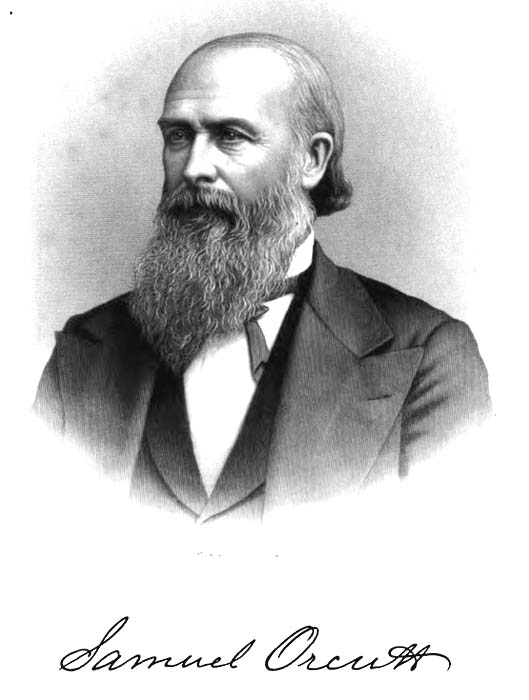
Samuel Orcutt |
SAMUEL
ORCUTT
Son of James and Celine (Crosby) Orcutt
was born in Berne, Albany county, N. Y. His grandfather,
Samuel Orcutt, a native of Connecticut, was a musician in
Washington's army in the Revolution most of the time the war
continued, and was killed by the falling of a tree when his twin
sons, James and Ezra, were only five years of age.
Samuel, the author of this book, and whose portrait is
the second in the book, attended the district school winters
until nineteen years of age, and he turned teacher instead of
pupil. When he was about fourteen, that great institution,
the district library, was established in the school district,
and his father being the librarian, he made diligent improvement
of the nearly 200 volumes secured, making many of them a regular
study instead of simply reading books. While teaching he
mastered the "Elements of Algebra" and Chemistry without a
teacher. He then took a two years' course of classical
studies at Cazenovia (N. Y.) Seminary, and Owego Academy.
Being licensed to preach, he supplied the pulpits of four
churches in central New York while taking a course of four
years' theological and historical studies under private but
regular and thorough recitation. He then took one year's
course of study in Hebrew and Greek under Prof. James Strong of
Flushing, L. I. After this he preached at Greenport and
Patchogue, L. I., (in the Congregational churches) four yeas;
then four years at William's Bridge, Westchester county, N. Y.
Following this he preached with much success at Riverhead, L.
I., fifteen months, and in the spring of 1872 removed to
Wolcott, Conn., where he supplied the pulpit nearly two years
and wrote the history of that town, which was published in 1874.
While preaching at Torrington, Conn., in 1874 and 5, he
collected largely the material for a history of that town, which
was published early in 1878.
While preaching several months at New Preston, Conn.,
in 1876, he collected considerable material for another work
(not local history) not yet published. He began as a
licensed preacher in 1848, when twenty-four years of age; was
ordained in 1851, and was regularly employed in his profession,
with the exception of a year and a half, until in 1875, a series
of twenty-seen years; and is now a member of the New Haven West
Association.
Source:
History of the Old Town of Derby, Connecticut, 1642 - 1880
with Biographies and Genealogies by Samuel Orcutt & Ambrose
Beardsley, M. D. - Publ. Press of Springfield Printing
Company, Springfield, Mass. 1880 - Page 678 |
| |
THOMAS
J. O'SULIVAN, M. D.
Was born at Preston, Conn., Mar. 1, 1852, his early education
being secured at Norwich Free Academy, Conn., and Nicholet
College, Canada, from which institution he graduated.
Entering the University of Vermont at Burlington, he took
one course of lectures and then went to Bellevue Medical
College, New York, where he received the degree of M. D. and
entered upon the practice of his profession at Worcester, Mass.,
where he is engaged in a good practice.
Source:
History of the Old Town of Derby, Connecticut, 1642 - 1880
with Biographies and Genealogies by Samuel Orcutt & Ambrose
Beardsley, M. D. - Publ. Press of Springfield Printing
Company, Springfield, Mass. 1880 - Page 629 |
| |
MRS. CATHARINE (JENNINGS)
PARSONS,
Daughter of Isaac Jennings, M.D., was graduated at
Oberlin College and became the wife of the Rev. Justin W.
Parsons. They went as missionaries of the A. B. C. F.
M., first to Salonica in European Turkey, thence to Smyrna,
thence where they are now, at the head of the missionary work,
including a prosperous boarding and a day school for girls, in
the Nicomedia mission field, having their residence in Batchejuk,
Turkey of Asia. One of her daughters, Miss Sella C.
Parsons, is assistant missionary teacher. Another
daughter, Mrs. Louisa S. Whiting, is a missionary of the
Presbyterian Board, near Shanghai in China.
Source:
History of the Old Town of Derby, Connecticut, 1642 - 1880
with Biographies and Genealogies by Samuel Orcutt & Ambrose
Beardsley, M. D. - Publ. Press of Springfield Printing
Company, Springfield, Mass. 1880 - Page 604 |
| |
ELEAZER PECK, son of
Benjamin C. Peck, of Woodbury, a descendant of Joseph
Peck of Stratford, in the seventh generation, was born
in Woodbury, Conn., in 1808. Removed to Derby in 1829;
was associated with David Bassett in the manufacture
of augers until 1845. About 1849 he left manufacturing
to engage in mercantile business in the new village of
Ansonia, and built the first store in that place. He
continued to be a successful merchant until 1870, when on
account of declining health he retired fro business.
He was twice married; first to Nancy Mansfield;
second, to Louise Martentrough, both
granddaughters of the Rev. Richard Mansfield, D. D. He
had one child by his first wife, a son, who died at six
years, and five children by his second wife, who all died in
childhood, except one daughter, Eliza, who married
A. W. Webster, Esq., and lives at present at the family
residence in Ansonia. Mr. Peck died
July, 1878.
Source:
History of the Old Town of Derby, Connecticut, 1642 - 1880
with Biographies and Genealogies by Samuel Orcutt & Ambrose
Beardsley, M. D. - Publ. Press of Springfield Printing
Company, Springfield, Mass. 1880 - Page 629 |
| |
GEORGE
HOBART PECK, fourth son of Ephraim Birdseye Peck
of Woodbury, removed to Birmingham in 1863, and succeeded
Mr. G. H. Corlies in the drug business, which he conducted
along until 1873, when he entered into a partnership with
Charles H. Coe, and the business is still conducted
under the style of G. H. Peck and Co. In 1866
Mr. Peck became a stockholder in the Star Pin
Company, a new interest in organizing for the manufacture of
pins, and was elected president of the company, which office
he held until 1875, when, by the purchase of stock, he
became more largely interested in the business; and upon the
resignation of Mr. J. Tomlinson, former secretary and
treasurer of the company, he was elected secretary and
treasurer and assumed the management of the business of the
company, which he still continues.
He was elected Judge of Probate, District of Derby, in
1869, 70, 71; was elected to Legislature in 1873; and has
been warden in the Church since 1866.
He was married in 1856 in Tecumseh, Mich., to Maria
P. Stillson, a daughter of David Stillson
formerly of Woodbury. Has three children: Ina
Gertrude, Irving Hobart and Howard Birdseye.
Source:
History of the Old Town of Derby, Connecticut, 1642 - 1880
with Biographies and Genealogies by Samuel Orcutt & Ambrose
Beardsley, M. D. - Publ. Press of Springfield Printing
Company, Springfield, Mass. 1880 - Page 629 |
| |
ROBERT
PECK, born in Woodbury, Conn., in 1825; the third son
of Ephraim Birdseye Peck of Woodbury, a descendant of
Joseph Peck of Stratford in the sixth generation.
Removed from Woodbury to Ansonia i 1870 to engage in the dry
goods trade, having purchased the long established business
of Mr. Eleazer Peck. He continued in trade till
1876, when he sold his stock, and soon after succeeded
Scott Brothers in the job printing business in
the village of Shelton, which he still continues, residing
in Ansonia as before.
For a number of years one of the burgesses of the
borough of Ansonia; in 1873 was elected warden; has been
trial justice for many years, and an active member of the
board of vestry of Christ's Church; has been twice married;
first to Catharine M. Farr, of Woodbury, who died in
1854. His second wife is Sarah L. Lindley, a
daughter of Ira Lindley, Esq., of Danbury, Conn.
They have one child, Minnie C. Peck.
Source:
History of the Old Town of Derby, Connecticut, 1642 - 1880
with Biographies and Genealogies by Samuel Orcutt & Ambrose
Beardsley, M. D. - Publ. Press of Springfield Printing
Company, Springfield, Mass. 1880 - Page 630 |
| |
DOCT.
JOSEPH PERRY was born at Quaker's Farm about 1727,
and died in Woodbury, April 29, 1793, in the sixty-sixth
year of his age. He is said to have been the third
English child born at Quaker's Farm. He prepared
himself for the practice of medicine and settled in Woodbury
about 1750. For more than forty years he was the
leading physician of the town and vicinity, and was
frequently called into neighboring towns in critical cases.
He fitted many during his long practice for the profession
he so much adorned. He also had much interest in the
civil affairs of the town and was frequently engaged in its
public business.*
He had a son Nathaniel, who was a
physician in Woodbury, and this Nathaniel's son was
the honorable Nathaniel Perry of Woodbury.
Source:
History of the Old Town of Derby, Connecticut, 1642 - 1880
with Biographies and Genealogies by Samuel Orcutt & Ambrose
Beardsley, M. D. - Publ. Press of Springfield Printing
Company, Springfield, Mass. 1880 - Page 630 |
| |
ANSON
GREEN PHELPS, whose name occurs so frequently in
these pages, was born in Simsbury, Conn., in March, 1781.
His father died when he was an infant, and his mother before
he was eleven years of age. He was placed under the
care of Rev. Mr. Utley, with whom he remained several years,
learning a trade. Mr. Phelps's father
was among the first who left Simsbury to join the army of
the Revolution, and served much of the time through the war
as an officer under Gen. Green,
and in memory of whom he named his son. His wife,
mother of Anson Green, a very excellent woman, was reduced
to indigent circumstances, and struggled hard to obtain a
living during the war. When her husband returned, only
to die, nothing was left her but worthless Continental
money.
At an early age Anson G. spent several winters
in Charleston, S. C., where he established a branch of
business. In 1815 he removed to New York city,
where he became largely identified with commercial
interests. His business, which was dealing in copper,
tin, brass, iron and lumber, became very extensive
throughout the country, resulting in the establishment of a
branch firm in Liverpool, England. He was among
the most prominent and successful business men in the
country. Having accumulated a fortune, he seemed to
take delight in starting new enterprises, and building
manufacturing villages, and the people of Derby owe him more
than a debt of gratitude that he was induced by Sheldon
Smith to turn a portion of his energies towards the
waste places of the town. After Mr. Smith sold his
interests in Birmingham, Mr. Phelps was the chief
pillar of support in sustaining the early growth and
prosperity of the place.
Ansonia, which bears its
derivative name from him, owes its existence to his
persevering efforts. He interested himself apparently
with no selfish ambition; was a promoter of the public good,
and encourage progress in all directions. Those who
recollect his operations in Derby, which were only a small
part of his business life, can appreciate his career, in
which, being incessantly employed in a great variety of
undertakings, he signalized his business talent by success
in nearly everything he attempted. Armed with an
invincible self-reliance, he took counsel chiefly of
himself, and often saw success where most other men
predicted defeat. He had an iron will, a comprehensive
judgment and power of combination, a physical constitution
capable of immense endurance, and by these he worked out
extraordinary success. He gave liberally of his ample
means to all benevolent objects, without regard to class or
sect. He took no active part in politics, although a
farm friend of the slave, and for many years was president
of the American Colonization Society, to which he
contributed largely. He enjoyed the personal esteem of
many eminent statesmen, such as Henry Clay, Daniel
Webster and others, who were often guests at his
house.
In his daily walk Mr. Phelps
was a model Christian. No business relations, however
important, were permitted to interfere with his devotions or
his duties to his church (Congregational) through his long
and useful career. This was the crowning fact of his
life, that, unlike most men in large business enterprises,
he carried his religion into almost every line and
department of work, and to his principle, he attributed his
success. His Sunday contributions were often more in
amount than that of all the congregation. He kept a
diary of his religious and business expenses for fifty
years. Long will the citizens of Derby hold him in
grateful remembrance. He died at New York in November,
1853, in teh 74th year of his age.
Source:
History of the Old Town of Derby, Connecticut, 1642 - 1880
with Biographies and Genealogies by Samuel Orcutt & Ambrose
Beardsley, M. D. - Publ. Press of Springfield Printing
Company, Springfield, Mass. 1880 - Page 630 |
| |
ALBERT W. PHILLIPS, M. D., was born at Marcellus,
N. Y., July 26, 1838, his early education being secured in
the common schools of his native town. He graduated
from the Hannemann Homoepathic College, Chicago, Ill., in
1861.
At the commencement of the Rebellion he enlisted as a
private in the 12th Regiment, New York State Volunteers, but
was afterward appointed hospital steward of the same
regiment, and later received the appointment of assistant
surgeon of the 149th Regiment of New York Volunteers, and
served until the close of the war, when he removed to
Birmingham. He has held the office of registrar of
vital statistics, and has also been an influential member of
the board of burgesses for several years. He has been
the only follower of the school "similia similbibus
curantur" in the town, and has a large and lucrative
practice.
Source:
History of the Old Town of Derby, Connecticut, 1642 - 1880
with Biographies and Genealogies by Samuel Orcutt & Ambrose
Beardsley, M. D. - Publ. Press of Springfield Printing
Company, Springfield, Mass. 1880 - Page 632 |
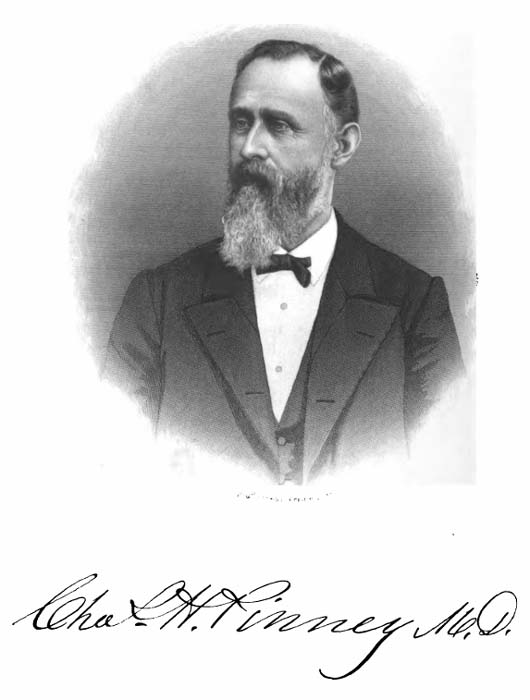
Chas. H. Pinney, M. D. |
CHARLES HITCHCOCK PINNEY, M. D.
Source: History of the Old Town of Derby, Connecticut,
1642 - 1880 with Biographies and Genealogies by Samuel Orcutt &
Ambrose Beardsley, M. D. - Publ. Press of Springfield Printing
Company, Springfield, Mass. 1880 - Page 633 |
| |
DAVID
W. PLUMB was born in Trumbull, Conn., Oct. 13, 1808.
His father, Noah Plumb, was a dealer in cattle, and
possessed a large farm on which his son worked while a boy.
His early education was obtained at the common school and
afterwards a short time at an academy. Upon the father
removing to Bridgeport, the son David went into a
store as clerk, and his employer failing in business, Mr.
Plumb bought the goods and removed them to Birmingham in
the spring of 1836, and built the stone factory on Main
street. Here he carried on the manufacture of woolen
goods, such as flannels, beavers and cassimeres, with
Benjamin B. Beach, for about ten years. Dissolving
this partnership he removed to Ansonia in 1848, and after
building a large factory continued the same business until
he sold to Wm. R. Slade in 1865. His business
in Ansonia was very successful during the war.
In 1868 Mr. Plumb removed to Shelton and became
much interested in the building and success of the Ousatonic
dam, investing largely of his fortune in the enterprise.
He was for some time president of the Ansonia Bank, also
treasurer and secretary of the Ansonia Savings Bank.
He represented Derby in the lower House in 1838, 1852, 1862
and 1853, and was senator from the fifth district in 1841.
Being a good debater he was a useful and an influential
member of the Legislature and has always been a firm
opponent of the democracy. He is the only man who has
represented Derby five times in the Connecticut Legislature,
which shows the estimation in which he has been held by the
community.
For his first wife he married, in 1841, Clarissa
Allen of Derby, and for his second he married, in
December, 1875, Louisa Wakelee of Huntington.
Source:
History of the Old Town of Derby, Connecticut, 1642 - 1880
with Biographies and Genealogies by Samuel Orcutt & Ambrose
Beardsley, M. D. - Publ. Press of Springfield Printing
Company, Springfield, Mass. 1880 - Page 636 |
| |
REV.
AMASA PORTER.
Was born in 1774, was graduated at Yale college in 1793, and
settled in Derby in 1797. The records show an unusual
anxiety on the part of the church to obtain him, and he was not
induced to accept the invitation until this desire was well
manifested, His first call was presented with a peculiarly
graduated scale of salary: £130 the
first year, £125 the second, £120 the third, and so down to
£100, where it was to remain. The committee were directed
to present this proposal to him, and if he was not suited, to
see what would be agreeable. Mr. Porter asked for
time to consider and consult the neighboring clergy. After
this the salary was fixed at £115 per annum, and the call
renewed, he being asked to supply in the meantime. The
call was finally declined.
The next step was to raise a fund of £500, the interest
of which was to be applied to the support of the gospel, if
Mr. Porter would come and preach. On this basis the
call was renewed and accepted. The agreement was kept and
the fund raised, which was probably the basis of the present
fund of the church. He was ordained the 20th of June,
1797, and proved to be an excellent man for the place, and there
is no evidence that the people were disappointed in him.
In the year 1804, Mr. Porter being in too feeble
health to supply the pulpit, the society passed a resolution
asking that, as they were unable to pay his salary in full and
supply the pulpit, he should relinquish one half of his salary,
and they would furnish the supply. To this Mr. Porter
seems to have agreed cordially, but, for some reason not given,
after a lapse of six months, a committee was appointed to carry
out a repeatedly expressed wish of his that he should be
dismissed. This was effected Mar. 20, 1805. After
his dismissal he removed to New Haven, where he died in the year
1856, at the age of eighty-two.
The late Rev. Charles Nichols writes of
this devoted good man as follows:
" knew him well in my early boyhood, and though after his
dismissal he removed to New Haven, I knew him and visited in his
family while pursuing my studies in the theological seminary.
He was I should say a little taller than the average man; well
formed, possessed of a countenance gentle and mild, and
distinguished excellence of character. I have no
recollection of having heard him preach. My full
impression is that he relinquished the ministry because of
bodily weakness or chronic disease.
"His wife was a Miss Bliss of Columbia in
Tolland county, Conn. They had two sons and two daughters,
and both the sons were graduates of Yale college.
"Mr. Porter was beloved by the people of Derby,
and long after he removed was spoken of by good people in terms
of respect. Probably no person now living in the town
remembers him more pleasantly, or with a more affectionate
interest, than the writer of this article."
Source:
History of the Old Town of Derby, Connecticut, 1642 - 1880
with Biographies and Genealogies by Samuel Orcutt & Ambrose
Beardsley, M. D. - Publ. Press of Springfield Printing
Company, Springfield, Mass. 1880 - Page
637 |
| |
LIEUT.
JABEZ PRITCHARD
Who enlisted in July, 1777, under Captain Carris, in the
regiment of Colonel Enos, was in command of
Major Humphreys near Fort Independence. In the
conflict at that place he, with others, was taken prisoner and
confined first at King's bridge, then in New York, and afterward
on a prison ship on the North River. His commission was
taken from him by his inhuman captors and he was so illy treated
that, like most of the other prisoners on that infamous ship, he
survived but a short time.
His generous and honorable character may be inferred
from the fact that he might have escaped being taken prisoner
but that he would not abandon a wounded comrade; and that he
afterward divided his funds with a fellow prisoner, to which act
of liberality Bradford Steele ascribed his own recovery, by
means of the provisions and comforts he was thus enabled to
procure.24
---------------
24. History of Seymour.
Source:
History of the Old Town of Derby, Connecticut, 1642 - 1880
with Biographies and Genealogies by Samuel Orcutt & Ambrose
Beardsley, M. D. - Publ. Press of Springfield Printing
Company, Springfield, Mass. 1880 - Page 638 |
* Woodbury History, I, 392.
|