|
BIOGRAPHIES
HISTORY OF
TOWN of DARBY,
NEW HAVEN COUNTY, CONNECTICUT
1642 - 1880
with
BIOGRAPHIES AND GENEALOGIES
By
Samuel Orcutt
Author of the Histories of Torrington and Wolcott, Conn.
AND
Ambrose Beardsley, M.D.
Published:
New York:
Press of Springfield Printing Company,
Springfield, Mass.
1880

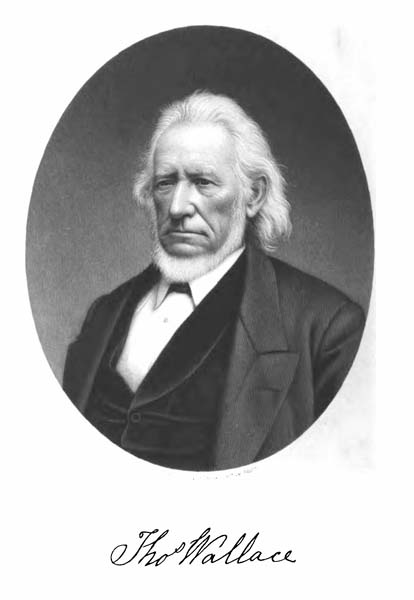
Thos Wallace |
THOMAS
WALLACE
Was born in Manchester, England, Nov. 15, 1797. His father
was an officer in the regular British army, and consequently
could give his son little attention; and the only advice the son
remembered to have received from the father was: "Thomas,
earn your clothes by honest industry, and they will wear like
iron." This remark was never forgotten. Thomas's
mother possessed a strong, cultured mind and gave him all the
early education he received. She was the first to start a
Sunday-school in Manchester, it being in her own house.
When fourteen years of age Thomas bound himself
to learn the trade of a wire drawer for pin making. During
his seven years apprenticeship he found time to improve his
mind, and developed strong radical views, rather obnoxious to
some of the English laws touching workingmen. In 1832,
determined to breathe the free air of republican institutions,
he came with his family to America and worked at his trade,
making his residence at Providence, R. I., Haverstraw on the
Hudson, and Bloomingdale, N. J., until 1835, when he removed to
Peekskill, N. Y., where he built a factory and carried on his
business nearly six years, but owing to the dishonesty of his
partner failed in business and became deeply involved in
obligations, which he afterwards paid in full.
In 1841 he came with his wife and nine children to
Birmingham, and worked about ten years for the Howe
Manufacturing Company, at his trade. In 1850 he commenced
operations for his factory in Ansonia.
The advent of the Wallace family has proved a
valuable acquisition to the town. Eleven marriages among
the first children have taken place, and all that now survive
reside in the community, and together with the grandchildren,
with one or two exceptions, are interested in the business which
Mr. Wallace established under the name of "Wallace
and Sons," showing that in union and harmony there is strength.
Mr. Wallace was not easily discouraged at
prominent difficulties, but possessed great powers of mental
endurance and perseverance, a mind replete with useful
knowledge, and few men had greater powers for diversified
conversation. Added to a fine physique, his personal
habits were a model for others. Temperate in all things he
despised all sorts of shams, "shoddy professions" and low tricks
of pretended cunning.
He represented Derby in the Legislature; was for many
years a most efficient member of the School Committee Board,
warden of the borough, besides filling many other positions of
trust.
His life was a success, and when his head was silvered
over with age he was gathered to his fathers, Apr. 30, 1875,
with many friends to mourn and no enemies to reproach.
Source: History of Town of
Derby, New Haven County, Connecticut - 1642 - 1880 - Page 663 |
| |
N.
J. WILCOXSON
Came to Oxford Nov. 30, 1825, and engaged in teaching the public
school, in which he continued one year. He was then
engaged as teacher of a select school in the same village which
he continued to teach two years. A select school has been
taught several seasons since that time in Oxford, but no regular
academy has been maintained.
Mr. Wilcoxson has been a prominent man in the
town, holding various offices such as town clerk and judge of
probate, many years.
Source: History of Town of
Derby, New Haven County, Connecticut - 1642 - 1880 - Page 666 |
| |
SAMUEL
WIRE
Born at Greenfield Hills, Fairfield county, Feb. 8, 1789, came
to Humphreysville when thirteen years of age (in 1802) to learn
the clothing business under General Humphreys. At
the age of twenty-three he married the sister of the late
Gen. Clark Woolster, who died after several years of happy
married life, without children. Mr. Wire soon after
commenced the manufacture of satin warps in the south part of
Oxford, and married his second wife, who was the daughter of
David Candee. He represented that town at several
sessions of the assembly, and held other important offices of
trust, being at one time the most influential politician in the
town. In 1847 he removed to New Haven, where he was
constable several years and then city sheriff. He was one
of the oldest Freemasons of the state, and a member of the
Franklin Chapter and Harmony Council. He was of genial
disposition, faithful and upright, and died May 3, 1874, aged
eighty-six years.27
---------------
27 History of Seymour
Source: History of Town of
Derby, New Haven County, Connecticut - 1642 - 1880 - Page 666 |
| |
GENERAL
DAVID WOOSTER
Was born Mar. 2, 1710, being the son of Abraham, and
grandson of Edward Wooster one of the first three or four
settlers of Derby. Abraham Wooster, father of the
general, removed from Derby about 1706, to Stratford, in the
south-east corner of what is now Huntington, where he remained
until about 1720, when he settled in Quaker's Farm, in Derby,
where he resided until his decease. Several deeds recorded
in Derby prove these statements, and in which he is said to be a
mason (i.e., a stone mason). He was living as late
as 1743. David was therefore born in Stratford, and
was ten or eleven years old when he removed with his father to
Quaker's Farm. He was graduated at Yale College in 1738.
Something more would probably have been known of his early life
but for the burning of all his family papers by the British when
they pillaged New Haven in 1779.
When the Spanish war broke out in 1739, he was employed
as first lieutenant, and in 1745, as captain of a coast guard.
In 1746 he married, in New Haven, the beautiful and accomplished
daughter of Thomas Clapp, who was president of
Yale College; but neither the society of a charming companion,
his love of classic lore, nor his youthful inclination for a
learned profession could restrain his devotion to the interests
of his country. He continued in the service, and was
appointed captain in Colonel Burr's regiment which
formed a part of the troops sent by Connecticut in the
celebrated expedition against Louisburg in 1745.
He there proved himself an active, spirited officer,
and bore a fortress. distinguished part in the siege and capture
of that strong fortress. He was retained among the
colonial troops to keep possession of the conquest he had
assisted in effecting, and he was soon after selected among the
American officers to take charge of a cartel ship for France and
England. He was not permitted to land in France, but was
received in England with distinguished honor. The young
American officer, as he was called, was presented to the King
and became the favorite of the court and the people. The
King admitted him in the regular service and presented him with
a captaincy in Sir William Pepperell's regiment, with
half pay for life. His likeness at full length was taken
and transferred to the periodicals of that day. The peace
of Aix-la-Chapelle, which took place in 1847, restored Louisburg
to France, and the young American officer to private life and to
his family.
He was not, however, permitted to remain long in this
situation, for the attempts at settling the boundaries between
the French and the English North American possessions having
proved vain, the war of 1756 followed; and in this great contest
Gen. Wooster was soon thought of as a man qualified for a
higher sphere, and was appointed colonel of a regiment raised in
Connecticut, and afterwards to the command of a brigade, in
which station he remained until the peace of 1763, when he
returned again to his family, bearing many marks of his valor
and intrepidity.
Soon after the close of this war he engaged in
mercantile business in New Haven, and held the office of his
majesty's collector of the customs for that part. He was
highly respected both in his private and public character.
In the great contest between England and the North
American colonies, Gen. Wooster took no doubtful part;
and although an officer in the British regular establishment,
entitled to half pay for life, he did not hesitate to take sides
with his native country, and his pen and his sword were actively
employed in the defense of its rights.
After the battle of Lexington he was fully aware that
the sword alone must decide the contest. Under these
circumstances he, as well as other military men of experience,
saw at once how important it was for the Americans to get
possession of the fortresses of the country, together with the
cannon, arms and military stores there deposited. The
peculiar situation of the fort at Ticonderoga, commanding the
great pass between the North Atlantic colonies and Canada, did
not escape his notice. He, therefore, with a few others of
a kindred spirit while engaged in the General Assembly in May,
1775, planned the expedition from Connecticut to seize upon and
regain that fortress; and to enable them to carry their plans
into execution, they privately obtained a loan of eighteen
hundred dollars from the treasury of the state, for which they
became personally responsible. Such was the secrecy and
dispatch in planning and executing this measure that on the 10th
of May, as is well known, this fort was surprised and delivered
up to Allen and Arnold, and their brave followers.
This step, one of the boldest taken at that period of the
contest, was at the sole risk and resonsibility of Gen.
Wooster and other individuals. Congress, when informed
of this transaction, recommended that an inventory of the cannon
and military stores found in the fort should be taken, "in order
as they say, that they may be safely returned when the
restoration of the former harmony between Great Britain and
these colonies, so ardently wished for by the latter, shall
render it prudent and consistent with the overruling care of
self-preservation."
The military experience, as well as the daring spirit
of Gen. Wooster, recommended him to Congress when raising
an army of defense, and among the eight brigadier-generals
appointed by that body on the 22d of June, 1775, he was the
third in rank. The operations of that year were
principally confined to the vicinity of Boston, and to an
expedition against Canada and Quebec, under the command of
Gen. Montgomery, who held the second rank among the
brigadier-generals. The death of their distinguished
leader under the walls of Quebec was severely felt by the
Americans.
During the campaign of 1776 Gen. Wooster was
employed principally in Canada, and at one time had the command
of the Continental troops in that quarter.
After this expedition he returned home and was then
appointed first major-general of the militia of his state.
During the whole winter of 1776-77 he was employed in protecting
Connecticut against the enemy, and particularly the neighborhood
of Danbury, where large magazines of provisions and other
articles had been collected by Americans. He had just
returned to New Haven from one of his tours when he heard on
Friday, the 15th of April, 1777, that a body of two thousand
men, sent from New York on the preceding day, had effected a
landing at Norwalk and Fairfield for the purpose of destroying
the magazines at Danbury, which object they accomplished the
next day, having found little or no obstacle on their way.
Immediately on hearing this news Gens. Wooster
and Arnold set off from New Haven to join the militia
hastily collected by Gen. Silliman. In consequence
of heavy rain the militia they had ordered to be sent to them
from New Haven did not arrive until the 20th in the evening in
the vicinity of Danbury. The number of the militia thus
collected was about six hundred men, and with this small force
it was determined to attack the enemy on the following morning
in their retreat, and for this purpose a part of the men were
put under the command of Gen. Wooster, and a part
under Gen. Arnold. With his handful of men
Gen. Wooster the next morning pursued the enemy,
regardless of the inequality of numbers. But being
inexperienced militia, and the enemy having several
field-pieces, our men, after doing considerable execution, were
broken and gave way. The General was rallying them when he
received a mortal wound. A musket ball took him obliquely,
broke his back-bone, lodged within him and could not be
extracted. He was removed from the field, had his wound
dressed by Doct. Turner, and was then conveyed to
Danbury, where all possible care was taken of him. The
surgeons were from the first aware of the danger of the case,
and informed the General of their apprehensions, which he heard
with the greatest composure. His wife and son had been
sent for, and arrived soon enough to receive his parting
benediction. He told them that he was dying, but with
strong hope and persuasion that his country would gain its
independence. How gloriously his presentiment has been
verified!
The symptoms soon became alarming, and on the second
day of May he died, at the age of sixty-seven. His remains
were deposited in the church-yard of that village, which he had
thus volunteered to protect.
The historian of that day (Gordon), in relating this
transaction, says of him: "The General behaved with great valor,
and lost his life gloriously in defending the liberties of
America, at the advanced age of seventy."
Duly sensible of the loss the country had sustained in
the death of Gen. Wooster, and justly appreciating his
merits and services, the lower House of Congress passed a
resolution in 1822, to erect a monument to Gen. Wooster
and that five hundred dollars should be appropriated for that
end, but the Senate did not concur, because of so many bills of
that kind being presented at that time.28
Although neglect is certainly involved in the long
delay in suitably marking the resting-place of the remains of
Gen. Wooster, it is yet a subject of congratulation that it
has resulted in the planting of a more beautiful and appropriate
shaft than would have been done by the comparatively small sum
proposed by Congress. This satisfaction is increased by
the reflection that the citizens of his native state, and
especially of the town he lost his life in defending, united in
the final consummation of the act of justice.
Of generous impulses,
"Large was his bounty and his
soul sincere,'
calm and unruffled under great
or minor public difficulties, of tall, fine, commanding personal
appearance those who knew him best have likened him to our
beloved Washington. Traduced, libeled, and even
insulted by jealous, designing officers, especially the
traitorous Arnold his name and virtues now stand out in
beautiful and shining contrast with the deeds of those who
maligned him while living. We must not forget that
General Wooster was a high toned Christian, and one of the
few who occasionally officiated as chaplain as well as chief of
his army, praying to the God of battles for success in a
cause which has shed its blessings upon untold millions.
The following sketch of the family of General David
Wooster was left in the hand-writing of Mrs. Maria Clapp
Turner, granddaughter of General Wooster.
"MRS.
MARY CLAPP WOOSTER was the widow of Gen. David Wooster,
who fell in defense of his country between Danbury and
Ridgefield. She was the daughter and only surviving child
of David Clap, President of Yale College. She
married at the age of sixteen, and was the mother of three
children, two daughters and one son, the eldest, a daughter,
died when not quite a year old.
"The properties of this lady's understanding and of her
heart were such as are rarely found in the same person.
The powers of her mind were strong, active and firm. These
were awakened, enlightened and enlarged by an early, uniform and
well regulated education. Her understanding was enriched
by a great variety of useful information. Her knowledge of
New England, particularly Connecticut was extensive and minute.
She was conversant with all the historical and natural
curiosities of this country. Her society was much sought,
and her conversation much enjoyed by persons of literature.
The pleasure in nothing these characteristics would be much less
than it is were we obliged to stop here. What most
distinguished, most adorned and most ennobled her was the gospel
of the Son of God. This she professed in early life, and
from that period to the day of her decease, lived steadily under
its influence. Though fervent and animated on all topics,
whenever she opened her lips on the subject of religion, her
fervor seemed to glow, and her animation kindled in proportion
to the magnitude of the subject. She was charitable to the
poor, sympathetic to the afflicted, and benevolent to all.
She passed through many scenes. Her early days were
strewed with flowers, but the later part of her life was full of
disappointments and afflictions. But all these troubles
she bore with rare equanimity and fortitude. As she
approached the close of her life, her relish for religion
increased, and her relish for everything else abated. Her
conversation was principally about heaven and heavenly things.
It was the result of choice, not of necessity. While her
body was a prey to disease, her soul seemed more and more above
this world. Her exhibition of the realities of religion
during the last days of her life, made these who conversed with
her forget all her former greatness, and proficiency in other
things. In the character of the Christian we are willing
to forget every other conspicuous trait which justly and
singularly belonged to her. Her light seemed to be truly
that of the just, which shineth more and more until the perfect
day. She was born in 1726, and died in New Haven at the
age of seventy-eight.
"Her son, Thomas Wooster, was sent to Europe.
ON his return he married Lydia Sheldon by whom he had
five sons and one daughter. He served as a colonel in the
Revolutionary war. After the war he went with his family
to New Orleans. Business rendered it necessary for him to
go to New Haven, and on his return to New Orleans the ship was
lost and he was never heard of. His widow with her family
returned to New York. Four of her sons went to sea, and
two were lost. The fifth son, Charles Whitney Wooster,
married Fanny Stebbins, daughter of Simon, who was
the son of Theophilus, who was the son of Boni (Benoni),
who built the house now standing in Ridgefield, between 1708 and
1761 (who was the son of Thomas of Deerfield, Mass., who
was the son of Roland, who came to this country in 1628,
who was the son of Sir Thomas of Suffolk county, in the
west of England). The house in Ridgefield has holes over
the door made by bullets which were fired when the battle was
fought in which Gen. Wooster was wounded.
"Charles W. Wooster had command of the forts
around the harbor of New York, during the three years' war of
1812, under the title of Major of the Sea Fencibles. After
the war he went to Chili, and was made admiral of their navy.
He died at San Francisco in 1848.
He had two sons; one died in infancy, the second,
Charles F. Wooster, was educated at West Point, served in
the Florida war, and the war with Mexico. At the battle of
Chihuahua, though Col. Doniphan had command, yet it was
through his advice and counsel the victory was gained; he gave
the directions of all hte movements. To use the words of
Major Porter, 'he didn't know what fear was.' His
talents were fine and he had all the qualities of an officer.
He was captain of the Fourth Artillery. He died at Fort
Brown, Texas, on the 14th of February, 1856, aged thirty-nine
years. His remains were brought to Brooklyn, and are
interred in the family lot in Greenwood Cemetery. His name
and his mother's (whose remains are there also) are on one side
of the monument and Stebbins on the other. By the
foregoing it will be apparent that four generations in
succession were in service of their country."
An
incident without romance occurred under Gen. Wooster's
command, which illustrates forcibly some of the characters that
upheld the Revolution, for had there not been much of this
decided and thorough character among the Americans,
notwithstanding all that was exhibited to the contrary, the
independence of the colonies would never had been gained.
Caleb Tomlinson of Huntington, father of
Charles Tomlinson not long since living in Huntington, aged
nearly four score years, was sent by Gen. Wooster with a
dispatch to Gen. Washington. Being from the same
neighborhood as Gen. Wooster young Tomlinson was
selected because the General knew him to be a plucky Yankee,
although a little uncultivated in his manners, and one to be
trusted for the discharge of duty.
Arriving at head-quarters he asked to see Gen.
Washington to which the guard replied: "You cannot see him."
"But I must, I have a dispatch for him from Gen. Wooster.
The guard reported to Gen. Washington, and returned
answer that he could be admitted. Washington was
seated at a rude table writing when Tomlinson handed him
the dispatch, and Washington on reading it nodded assent
and asked, "Anything more? "Nothing but an answer direct
from you," said Tomlinson. "Do you presume to tell
me what I must do," inquired the General. "No
General, but I'll be damned if I leave these quarters without
something to show that I have discharged my duty as a soldier."
Rising from his seat Washington remarked, "You are from
Connecticut, I perceive." "I am, sir," was the reply.
Tapping him on the shoulder the General said, "Young man, I wish
to the God of battles I had more such soldiers as you.
You shall be granted your request."
---------------
28 Benson J. Lossing's "Field Book of
the Revolution."
Source:
History of Town of
Derby, New Haven County, Connecticut - 1642 - 1880 - Page 667 |
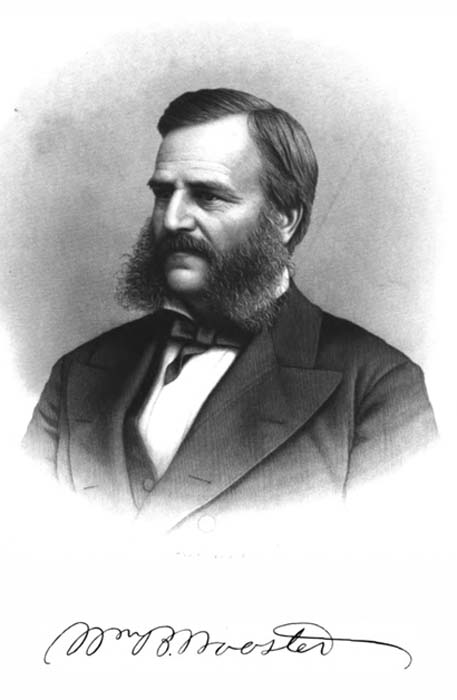
Wm. B. Wooster |
COL.
WILLIAM B. WOOSTER
Was born in Oxford, Conn., Aug. 22, 1821, being the son of
Russell Wooster, a thrifty farmer, who cultivated large
fields of rocky land. In early life the son William
worked on the farm summers, and taught the village school
winters. Becoming tied of swinging the scythe and
following the plow, he resolved to strike out for himself; and,
choosing for his calling the profession of the law, he entered
the Law School at New Haven and studied under Samuel
Hitchcock, Isaac Townsend and the late Chief Justice
Storrs and was admitted to the bar in 1846. He located
in Derby Oct. 1, 1846, and ever since has been a most successful
and popular legal advocate.
Although not an office-seeker, yet he has consented to
serve the town in many places of trust; twice representing Derby
in the Legislature, - once in 1858 - and was senator from the
fifth district in 1859. His labors in the House were very
valuable in 1861, in connection with Judge Elisha Carpenter
and other members of the military committee, when the act for
the benefit of widows and children of the soldiers of the state
was passed, for which measure Wooster, who drafted the
bill, received deservedly great commendation.
Active in the campaign of 1856, he was more so in the
one that elected the lamented Lincoln. On the
outbreak of the Rebellion he was very earnest in taking steps to
suppress it. One day a neighbor said to him in his office,
"What is Derby to do in this war?" He replied with
earnestness, "I don't know what will be done, but I have
resolved to close my office and enlist, for I think it is my
duty." He at once issued a poster for a public meeting,
which convened at Nathan's Hall, and about $3,000 were raised by
subscription towards encouraging volunteers. He enlisted
in 1862, and Governor Buckingham gave him the appointment
of lieutenant colonel of the 20th Regiment and he served until
the close of the war. He was in command of his regiment at
the battle of Chancellorsville. He was captured with
Capt. A. E. Beardsley of Derby, Capt. W. W. Smith of
Seymour and a few others, and set to the dungeon of Libby
prison. After being exchanged, Col. Wooster was
again at the head of his broken regiment and participated in the
famous battle of Gettysburg. In both of these engagements
he showed himself a brave officer, and by his military skill
endeared himself to his soldiers. In 1864 he was appointed
to be colonel of the 29th Regiment, colored, which position he
accepted. Leaving New Haven March, 1864, he was ordered
south, and after some months' service there resigned his
position a little before his regiment returned home. Under
Gen. Joseph R. Hawley, Col. Wooster was paymaster general of
his staff.
Col. Wooster made a brilliant war record, and
his services were an honor to Derby and the state.
In reality a self made man, possession native talent,
stern integrity and resolute mind, yet kind and tender-hearted,
he has elevated himself to his present position by his own
exertions, yet to modest that it was difficult to secure his
consent to placing his portrait in this book.
As a lawyer he ranks among the first in the state, and
maintains as enviable reputation.
Source: History of Town of
Derby, New Haven County, Connecticut - 1642 - 1880 - Page 674 |
|