|
BIOGRAPHIES
HISTORY OF
TOWN of DARBY,
NEW HAVEN COUNTY, CONNECTICUT
1642 - 1880
with
BIOGRAPHIES AND GENEALOGIES
By
Samuel Orcutt
Author of the Histories of Torrington and Wolcott, Conn.
AND
Ambrose Beardsley, M.D.
Published:
New York:
Press of Springfield Printing Company,
Springfield, Mass.
1880

| |
THE
REV. JOSEPH SCOTT.
A graduate of Washington, now Trinity College, Hartford, was
rector of St. James's parish eight years, between the
rectorships of Revs. Stephen Jewett and William Bliss
Ashley. A terrible sickness, while in Derby, broke
down his constitution and he was obliged to accept a smaller
parish at Naugatuck, where he died much lamented, in the
fifty-first year of his age. While rector of St. James he
was noted for his urbanity of manners and his meek and
consistent walk as a Christian minister.
Source: History of the Old Town of Derby, Connecticut,
1642 - 1880 with Biographies and Genealogies by Samuel Orcutt &
Ambrose Beardsley, M. D. - Publ. Press of Springfield Printing
Company, Springfield, Mass. 1880 - Page
643 |
| |
CHARLES
W. SHEFFREY, M. D.
Was born at Birkenhead, England, in 1834, and came to this
country when quite young with his parents who settled at New
Haven, Conn., where he obtained his early education, and
afterwards attended the Holy Cross College, Worcester, Mass.,
finally graduating at Yale Medical School in 1861. During
the war Doctor Sheffrey was assistant surgeon in
Connecticut volunteers, and in 1866 settled in Ansonia where he
resided five years, during which time he enjoyed a large
practice. In 1871 he removed to Bridgeport, Conn., where
he is at present practicing his profession.
Source: History of the Old Town of Derby, Connecticut,
1642 - 1880 with Biographies and Genealogies by Samuel Orcutt &
Ambrose Beardsley, M. D. - Publ. Press of Springfield Printing
Company, Springfield, Mass. 1880 - Page
645 |
| |
HORACE
M. SHEPARD.
Was the first lawyer who located in Humphreysville, then a part
of Darby. He was from Newtown and son of Col. Timothy
Shepard, a prominent lawyer of the Fairfield county bar.
He remained but a short period after Alfred Blackman
located at that place.
Source: History of the Old Town of Derby, Connecticut,
1642 - 1880 with Biographies and Genealogies by Samuel Orcutt &
Ambrose Beardsley, M. D. - Publ. Press of Springfield Printing
Company, Springfield, Mass. 1880 - Page
647 |
| |
REV.
JOHN D. SMITH
Was born in Derby, Feb. 12, 1804, being the son of Sheldon
Smith, who was an industrious farmer but unable to give his
son more than a common school education. John D.
kept school winters and studied what time he could command, with
Rev. Stephen Jewett, with whom after obtaining a good
knowledge of the classics he pursued his theological studies,
and was ordained deacon, July 7, 1833, at Hartford, and advanced
to the priesthood Sept. 22, 1834, by Bishop Brownell.
He took charge of Union church, now Trinity, at Humphreysville
at Easter, 1834, and was its rector nearly until his death,
Sept. 4, 1849, aged forty-five years.
Mr. Smith was an original thinker and one of the
active laboring ministers of his day. His salary for a
while was inadequate to his support, and he was obliged to unite
other pursuits with his ministerial labors. He was
poor-master for some time and also kept a book-store.
Source: History of the Old Town of Derby, Connecticut,
1642 - 1880 with Biographies and Genealogies by Samuel Orcutt &
Ambrose Beardsley, M. D. - Publ. Press of Springfield Printing
Company, Springfield, Mass. 1880 - Page
646 |
| |
SHELDON
SMITH.
There were two Sheldon Smiths who lived at the
Neck, neighbors, relatives by marriage, farmers, who have
recently died. They were both conspicuous in town matters.
Sheldon the senior was many years selectman, and
represented the town in the Legislature, and was instrumental in
building the first Methodist church in Birmingham. He was
the father of thirteen children including the late Rev. John
D. Smith of the Episcopal church. He died in 1867,
aged eighty-six years, after a well-spent, useful and Christian
life.
Sheldon the junior was for twenty years
selectman and town agent of Derby, and perhaps no officer of the
town was more watchful of its interests than he. Of an
inquiring and logical mind, well-read in the statutes, it may be
said that few lawyers in the state were better posted on the
pauper laws than he, and in consequence of this he was
often consulted by selectmen of adjoining towns. Both
these Smiths were highly influential, and their ancestors
were interested in the early agricultural interests of the town.
He died Oct. 10, 1866, aged sixty- nine years.
Source: History of the Old Town of Derby, Connecticut,
1642 - 1880 with Biographies and Genealogies by Samuel Orcutt &
Ambrose Beardsley, M. D. - Publ. Press of Springfield Printing
Company, Springfield, Mass. 1880 - Page
647 |
| |
BRADFORD
STEELE.
Son of Capt. Bradford Steele, enlisted July 10, 1777, at
the age of sixteen under Captain Cor_is, regiment of
Colonel Enos, and was at first stationed at Horseneck but
soon after ordered to join a branch of the Continental army
under the command of Major Humphreys. They marched
to Peekskill and there joined the army and marched to
Westchester, about two thousand strong, having two pieces of
artillery. At the battle of Fort Independence Steele,
with Lieutenant Pritchard and others, was taken
prisoner. One of their number becoming deranged under his
sufferings, the British soldiers beat him with their muskets,
then tied him on a horse, took him to King's bridge and threw
him over, leaving him with his head and shoulders buried in the
mud. At night Steele and thirteen companions were
placed in a small tent guarded by Hessian soldiers, and
if any one pressed out the tent-cloth he was sure to feel the
prick of the bayonet. Next day they were taken to the
Sugar House, where most of the prisoners had nothing to eat for
three or four days. They were then allowed four ounces
each of wormy sea-biscuit and four ounces of Irish pork daily.
About the first of December they were put on board a
ship in the North river. After fifteen days the small-pox
broke out, and Steele and twenty-five others were taken
to the hospital where they had so little care that only four of
the number survived. Steele was one man with his
feet so frozen that after a time they dropped off at the ankles.
One day while he was imprisoned in the Sugar House a well-known
tory came along and was allowed by the guard to pass in, when
the prisoners seizing him, dragged him to the pump and gave him
a thorough drenching; he was then allowed to run, the prisoners
saying good-by with a shower of brick. On the 8th of
August, 1778, the few surviving prisoners received tidings that
they were to be exchanged. Said Steele: "On the
next day we were all called out and paraded in the prison yard.
To behold such a company of living skeletons one might almost
imagine that the prophecy concerning the dry bones had been
fulfilled in us." On August 16th, they were landed at
Elizabethtown Point and were marched to the meeting-house, where
the exchange was made. Steele and three others who
were too much reduced by their sufferings to be capable of any
further military service were discharged and returned home.
After some months he recovered his health, and was for many
years a highly respected citizen of Humphreysville, and deacon
of the Congregational church. He died Dec. 24, 1841, aged
eighty years.25
---------------
25 History of Seymour.
Source: History of the Old Town of Derby, Connecticut,
1642 - 1880 with Biographies and Genealogies by Samuel Orcutt &
Ambrose Beardsley, M. D. - Publ. Press of Springfield Printing
Company, Springfield, Mass. 1880 - Page
647 |
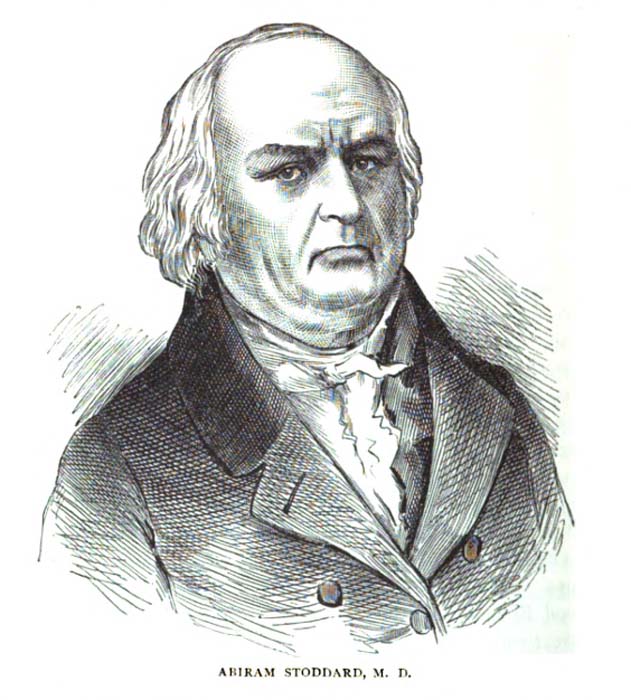
Abiram Stoddard, M. D. |
ABIRAM
STODDARD, M. D.
Was born in Watertown, Jan. 27, 1777, and was an industrious boy
with peculiar characteristics, and after his preparatory studies
entered Yale College and was graduated in 1800. He
attended medical lectures in company with Doct. Eli Ives
of New Haven, at the Medical University of Philadelphia, where
he received his degree of M. D. He was also the private
pupil of the eminent Doct. Rush. When attending
lectures he often rode from Watertown to Philadelphia and
returned on horseback.
On the death of Doct. Samuel Sanford, the first
physician of Chusetown, Doct. Stoddard located at that
place, in 1804. He soon succeeded to a large and lucrative
practice and became an Esculapian oracle among the people.
He was a bold practitioner in the methods of his day, - the
lancet, calomel and jalap being his king remedies. Full of
eccentricities, yet having the confidence of his patients, he
could do and say what would be ruinous to other physicians.
So he was often peculiar i his prescriptions. One day he
was sent for to see an hysterical woman in Watertown. All
the noted doctors had tried in vain to cure her. After a
thorough examination he said to the husband, "Have you any
raccoons in this vicinity?" "Plenty of them, Doctor," was
the reply. "Well, tell the boys to kill four or five, skin
them and make a jacket of them, and skin to skin let her wear it
two weeks, and in the meantime you may amuse her with the music
of a fiddle, - no medicine - then come down and let me know how
she is getting along." This was something new, but at the
end of two weeks the jacket had become very unpleasant to the
olfactories. The disconsolate husband sent the boy to
report. Meeting the doctor he said, "Mother is no better."
"Did you make the jacket?" "Yes." "Has she worn it?"
"Yes." "And is no better?" "None." "Did you
cut the tails off?" "Yes." "There it is; I didn't
tell you to do that: the whole curative virtue was in the
tails."
He was odd among his fellow physicians and delighted,
seemingly, in an opposite opinion. On a certain occasion
Doctor A. Beardsley had a patient in whom the community
had a deep interest in the recovery. This patient was not
a particular favorite of Doctor Stoddard. Partly by
appointment and partly by accident, a consultation was held.
Doctor Charles Hooker, the eminent Doctor Knight,
and the then young Doctor P. A. Jewett from New Haven,
Doctor Joseph Tomlinson of Huntington, Doctor E.
Middlebrook of Trumbulll, Doctor Stoddard and the
attending physician, were present. After the examination
of the patient, the medical advisers retired to the councilroom.
Doctor Hooker, who had seen much of the case, stated that
his "diagnosis was that the disease was chronic pleurites, with
copious effusion of serum water, - at least seven pints in the
left cavity of the thorax." Doctor Stoddard, then
the oldest of the council, standing in one corner of the room
leaning upon his staff, replied, "Not a d___n drop." The
doctors looked a little confused. Doctor Knight
expressed his views, that he was not in the habit of measuring
water in the living body, but the amount must be considerable.
"Not a d__n drop." Doctor Jewett said he was sure
there was "a large collection of water in the chest." "Not
a d__n drop." Doctor Middlebrook said that he
"agreed with the physicians, and unless the accumulation of
water could be removed the patient must die." "Not a d__n
drop; I disagree with you all," replied Doctor Stoddard.
"Then what is the matter?" was the inquiry. "Let us
have your views." "Nothing but sap run down from his head
into his chest, and he will get well." this closed the
council, and that worthy patient is still living.
Doctor Stoddard had a wide reputation and was
deemed eccentric in his manners; was strong-minded, and in his
way quite influential. He accumulated a handsome fortune
from his practice, and departed this life Dec. 23, 1855, aged 79
years.
Source: History of the Old Town of Derby, Connecticut,
1642 - 1880 with Biographies and Genealogies by Samuel Orcutt &
Ambrose Beardsley, M. D. - Publ. Press of Springfield Printing
Company, Springfield, Mass. 1880 - Page
651 |
| |
THOMAS
STODDARD, M. D.,
Son of Doctor Abiram Stoddard, M. D., was graduated at
Yale Medical School, and after several years' practice since
1836, retired to farming and has nearly given up his profession.
Source: History of the Old Town of Derby, Connecticut,
1642 - 1880 with Biographies and Genealogies by Samuel Orcutt &
Ambrose Beardsley, M. D. - Publ. Press of Springfield Printing
Company, Springfield, Mass. 1880 - Page
654 |
| |
LEMAN
STONE
Was born in Litchfield, Conn., in 1751, where he was engaged as
a farmer some years. He sold his possession there about
1785 and came to Derby soon after, where he engaged as a
merchant. At that time and during the Revolution the
Landing was the centre of mercantile operations, and during its
days of prosperity, from about 1790, no man is referred to more
than Leman Stone as an enterprising business man.
With great energy and expense to himself he pursued different
public enterprises with a view to the general good of the
community, especially the building of a stone-house and wharf,
and the New Haven turnpike; but the turn which the drift of
trade took was against his financial plans, whereupon he turned
his attention to the raising of garden seeds with Benjamin
Hodge, a cooper by trade, as his assistant, which resulted
more to his benefit than mercantile trading had done. He
was a conscientious, upright, public spirited man; sacrificed
much for the early prosperity of the town, and no man was more
highly respected than he as a Christian gentleman. He died
May 10, 1847, aged ninety-six years, and the place where his
remains lie in the old Episcopal church-yard had no headstone
until within a few years since, when some grateful friends
erected a suitable slab to his memory.
Source: History of the Old Town of Derby, Connecticut,
1642 - 1880 with Biographies and Genealogies by Samuel Orcutt &
Ambrose Beardsley, M. D. - Publ. Press of Springfield Printing
Company, Springfield, Mass. 1880 - Page
655 |
| |
DOCT.
NOAH STONE
Was a physician in active practice in Oxford many years; held
many offices of trust; judge of probate, justice of the peace,
town clerk and treasurer; and was a respected and honored
citizen.
His daughter, Martha Stone, was a well educated
lady and married Rev. Stephen Hubbell, a congregational
minister, Oct. 30, 1832, and became the authoress of a book
called "Shady Side" which had a sale of forty thousand copies,
and was said to have had a greater influence to increase the
salaries of ministers throughout New England, and to have
awakened a more just consideration for ministers' families, than
any one thing that had transpired. She afterwards wrote
other works, and her manuscripts were in great demand by
publishers.
Mrs. Hubbell's health gradually declined and her
useful career was brought to a close at life's high noon, at the
age of two score and two years.
Source: History of the Old Town of Derby, Connecticut,
1642 - 1880 with Biographies and Genealogies by Samuel Orcutt &
Ambrose Beardsley, M. D. - Publ. Press of Springfield Printing
Company, Springfield, Mass. 1880 - Page
655 |
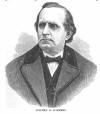
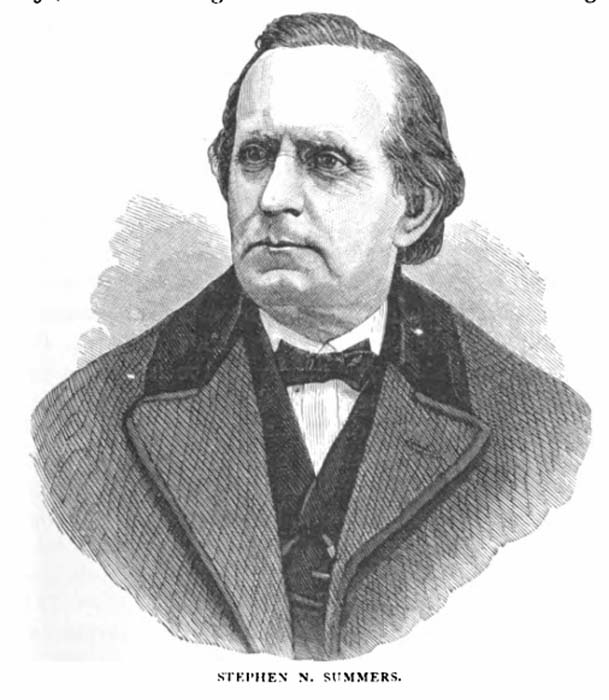
Stephen N. Summers. |
STEPHEN N. SUMMERS,
Source: History of the Old Town of Derby, Connecticut,
1642 - 1880 with Biographies and Genealogies by Samuel Orcutt &
Ambrose Beardsley, M. D. - Publ. Press of Springfield Printing
Company, Springfield, Mass. 1880 - Page 656 |
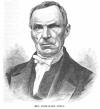
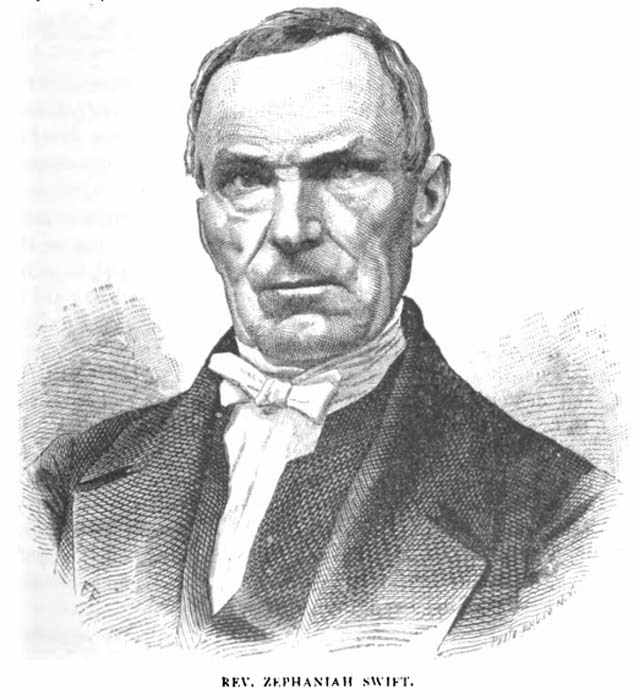
Rev. Zephaniah Swift |
REV. ZEPHANIAH SWIFT
Source: History of the Old Town of Derby, Connecticut,
1642 - 1880 with Biographies and Genealogies by Samuel Orcutt &
Ambrose Beardsley, M. D. - Publ. Press of Springfield Printing
Company, Springfield, Mass. 1880 - Page
658 |
| |
WILLIAM
TERRY, M. D.
Was born at Enfield, Conn., in 1822. His early education
was obtained in the public and private schools of his native
town, and at Amherst College one year. He graduated from
the medical department of the Pennsylvania College,
Philadelphia, Penn., in 1846, and was for a number of years
located at Sutton, Mass., and came to Ansonia in 1860.
During the Rebellion Doctor Terry was assistant surgeon
of the U. S. Military hospital at Alexandria, Va. He has
been a member of the town school committee and registrar of
vital statistics. Naturally of a modest disposition he has
declined accepting public offices, and given his attention to
the practice of his profession, thereby establishing a lucrative
business and a high standing as a physician.
Source: History of the Old Town of Derby, Connecticut,
1642 - 1880 with Biographies and Genealogies by Samuel Orcutt &
Ambrose Beardsley, M. D. - Publ. Press of Springfield Printing
Company, Springfield, Mass. 1880 - Page
661 |
| |
REV.
GEORGE THATCHER, D. D.,
Son of Peter and Anne (Parks) Thatcher, was born in
Hartford, Conn., July 25, 1817. Prepared for college at
Hopkins grammar School, Hartford; was graduated at Yale College
in 1840, and at Yale Divinity School in 1843. He came to
Derby in June, 1843; was ordained here Jan. 4, 1844, and
dismissed Oct. 10, 1848. He was installed at Nantucket,
Mass., Nov. 14, 1848, dismissed May 14, 1850; installed in Allen
Street Presbyterian church, New York city, May 26, 1850,
dismissed Oct. 9, 1854; installed in First church, Meriden,
Conn., Nov. 16, 1854, dismissed Sept. 18, 1860; installed at
Keokuk, Iowa, Oct. 30, 1860, dismissed Apr. 8, 1867. After
spending some months in Europe he supplied the Mercer Street
church for a time, and then became the acting pastor at
Waterloo, Iowa, where he continued three years. He was
president of the State University of Iowa from 1871 to 1877;
then acting pastor in Iowa City one year; received the honorary
degree of D. D. from Iowa and Knox Colleges in 1871. He
died in Hartford, Conn., of disease of the brain and heart, Dec.
27, 1878, aged 61 years.28
---------------
28 Cong. Year Book, 1879.
Source: History of the Old Town of Derby, Connecticut,
1642 - 1880 with Biographies and Genealogies by Samuel Orcutt &
Ambrose Beardsley, M. D. - Publ. Press of Springfield Printing
Company, Springfield, Mass. 1880 - Page
661 |
| ` |
JOHN
L. TOMLINSON
Was born in Derby, and read law with Dudley. His
office was in one of the chambers of the ancient house now
occupied by Miss Rachel Smith and her two sisters.
He succeeded Josiah Dudley; the latter, as near as can be
ascertained, was the first educated lawyer located in Derby
Narrows. He is represented as being a man of talent, but
died early from amputation of the leg. During the
shipwreck of the derby Fishing Company, when many of the people
were mortgaging their property to secure the company their
negotiable notes, it is said he had a lively business day and
night. Tomlinson was in the war of 1812, being
first lieutenant in a company from Derby stationed at New
London. Well read, and of a discriminating mind, he was
not a very successful advocate at the bar. The latter
years of his life were under the shadow of a great cloud, by his
unfortunate connection with the Derby Bank, which failed in 1825
through the legerdemain of Wall street brokers. The
popular belief awards Mr. Tomlinson the credit of being
honest in his transactions with the bank. Prior to his
leaving Derby in 1832 his spirits were enlivened by brighter
hopes of the future, for he entered the ministry of the
Congregational church, in which he labored with much zeal; went
west, where he died, aged about 70 years.
Source: History of Town of
Derby, New Haven County, Connecticut - 1642 - 1880 - Page 662 |
| |
HON.
DAVID TORRANCE.
Few public men of to-day enjoy a wider popularity than Hon.
David Torrance. He was born at Edinburgh, Scotland,
Mar. 30, 1840, and came early to this country with his mother
and located at Greenville, Conn., where he found employment as
an apprentice in a paper mill, in which he continued until his
enlistment.
He entered the Union army in 1862, as a member of the
18th Regiment, C. V., but his intelligence and aptitude for
command led to his speedy promotion to the lieutenant-colonelcy
of the 29th Regiment (colored), in which he served until the
close of the rebellion.
On his return from the war he came to Birmingham and
studied law with Col. William B. Wooster, and was
admitted to the bar in 1858, and since then, being associated
with Col. Wooster in the practice of his profession, he
has worked his way to an enviable position at the bar. In
1871 and 72 he represented Derby in the Legislature at a time
when the town had but one representative, and distinguished
himself by a number of able speeches and conscientious work as a
legislator - notably in the preparation of the schedule for
railroad returns adopted at the session of 1872.
Col. Torrance was elected by the republicans in
1879 to the office of secretary of state, and has proved himself
an able and efficient officer in that position.
Source: History of the Old Town of Derby, Connecticut,
1642 - 1880 with Biographies and Genealogies by Samuel Orcutt &
Ambrose Beardsley, M. D. - Publ. Press of Springfield Printing
Company, Springfield, Mass. 1880 - Page
662 |
|